


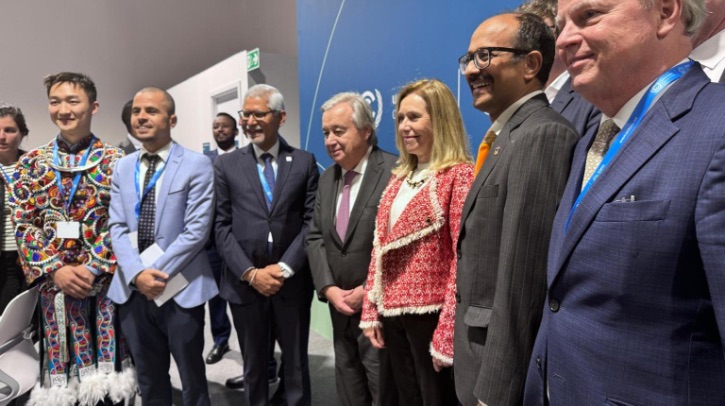
At COP29 in Baku, Azerbaijan, the WMO convened a top-level event on the UN secretary-general’s Early Warnings for All (EW4All) initiative, which has expanded to 30 more countries through 14 more projects.
Initially, 30 countries were prioritized for fast-track action. With this expansion, new partners and private-sector participants are being brought on board to ensure broader reach and impact. They will join the 193 existing WMO members and implementing partners, which include UNDRR, WMO, the International Telecommunications Union (ITU) and the International Federation of Red Cross and Red Crescent Societies (IFRC).
Global updates
Throughout the event, attendees heard calls from government leaders for a major effort to scale up investment – through public-private partnerships and providers of bilateral and multilateral funds – and simplify access to early warning system finance. Despite advances in technology and innovation, from mobile phones to machine learning (ML) and AI, there are still significant challenges in connecting all relevant actors and adapting to on-the-ground realities.
“This is on track to be the hottest year in the history books,” said UN secretary-general António Guterres, who convened the event. “It has scorched countries and communities with temperatures that push the limits of human endurance. And around the world, we’ve seen record rains and hurricanes, historic fires and deadly droughts. In this era of climate catastrophe, early warning systems and protection from extreme heat are not luxuries. They are necessities and sound investments – early warning systems provide an almost ten-fold return.” Specifically, COP29 president Mukhtar Babayev cited estimates that investment in early warnings could avert losses of up to US$16bn per year.
The President of the Federal Republic of Ethiopia, Taye Atske Selassie, recalled the prolonged drought and more recent flooding and landslides that have claimed so many lives and displaced many thousands of people. He stated that his country is committed to strengthening investment in hydrometeorological capacity and early warnings.
Similarly, the President of the Maldives, Dr Mohamed Muizzu, said his island nation is strengthening impact-based forecasting systems to enable enhanced forecasting and timely alerts that reach everyone at the right time and in the right place.
Greek Prime Minister Kyriakos Mitsotakis recalled devastating fires that have caused repeated tragedies in his country – testimony that was echoed by numerous other government ministers at the event.
The event also brought together senior representatives of development and philanthropic organizations, donor governments, technology companies and civil society.
“The climate crisis demands a collective, ‘whole-of-society’ approach, reaching across sectors and disciplines,” said WMO secretary-general Celeste Saulo. “Broadening the tent is not just about involving more actors; it’s about empowering everyone to champion early warning systems as a core priority.” She added that national meteorological and hydrological services are the linchpins of early warnings.
Multi-hazard early warning systems
The delegates also discussed the findings of the WMO’s latest Global Status of Multi-Hazard Early Warning Systems (MHEWS) report, which sets out the latest data and findings relating to the coverage and comprehensiveness of MHEWS globally, with 12 key findings supported by a series of recommendations to scale up action to save lives and change lives. According to this year’s report, the world is at its highest levels of reported early warning coverage since 2015. However, there reportedly continues to be a disproportionate impact of disasters on certain countries. The research showed that countries with less comprehensive MHEWS have a disaster-related mortality ratio that is nearly six times higher than that of countries with ‘substantial’ to ‘comprehensive’ coverage and nearly four times more disaster-affected people.
“Progress remains uneven. Half of the countries in Africa and only 40% of countries in the Americas and the Caribbean have reported the existence of multi-hazard early warning systems,” wrote Saulo and Kamal Kishore, special representative of the UN secretary-general for disaster risk reduction and head of the UN Office for Disaster Risk Reduction (UNDRR). “But even among countries with such systems, many still have gaps in one or more of the four pillars: risk knowledge, forecasting and detection, warning dissemination, and early action.”
Follow-up on extreme heat
At the event, there was a specific focus on extreme heat, as more than 70% of the global workforce – 2.4 billion people – are now at high risk of this phenomenon.
In July 2024, Mr Guterres launched a Call to Action on Extreme Heat to underscore a concerted effort to enhance international cooperation in four critical areas: caring for the vulnerable; protecting workers; boosting the resilience of economies and societies using data and science; and limiting temperature rise to 1.5°C by phasing out fossil fuels and scaling up investment in renewable energy.
Modeled estimates show that between 2000 and 2019, approximately 489,000 heat-related deaths occurred each year, with 45% of these in Asia and 36% in Europe. Worldwide, the official diagnosis and reporting of heat-related illness, injuries and deaths are recognized to be under-reported. The WHO and WMO estimate that the global scale-up of heat health-warning systems for 57 countries alone has the potential to save an estimated 98,314 lives per year.
The WMO-WHO Joint Office for Climate & Health spearheads the Global Heat Health Information Network as a key mechanism for partnership, knowledge and user engagement. Standard occupational safety measures responding to extreme heat could save over US$360bn a year, according to Guterres.
“Now, we are developing a package of solutions on extreme heat to support countries to act. I ask them to do so urgently, before the next heat wave strikes,” he said.
In related news, WMO recently produced a multi-agency report on global climate services. Click here to read the full story.