


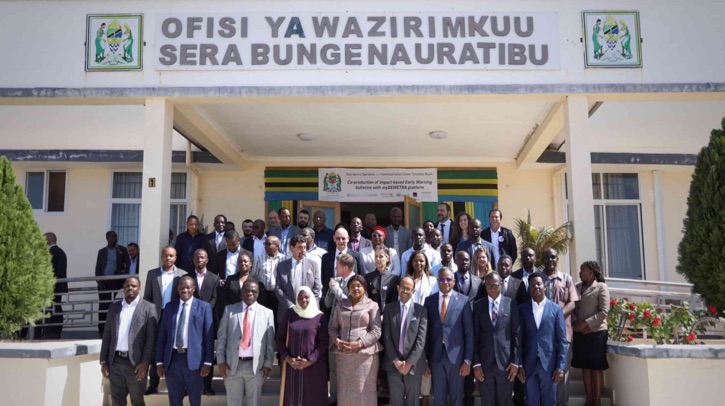
Tanzania has inaugurated its first Emergency Operation and Communication Center (EOCC) Situation Room. This is also the first national situation room to be set up under the African Union’s Africa Multi-Hazard Early Warning and Early Action System (AMHEWAS) program.
Tanzania’s first Emergency Operation and Communication Center Situation Room
Working under the authority of the Prime Minister’s Office, the EOCC Situation Room will work to combine real-time data on current and emerging risks with data on past disasters to issue timely forecasts and bulletins. These products, through the coordination and support of the Prime Minister’s office, will aim to trigger protective actions that can save lives, protect livelihoods and safeguard economic sectors.
Over two years, the UN Office for Disaster Risk Reduction (UNDRR) has provided technical support for its establishment, in partnership with the CIMA Foundation and with generous funding from the Government of Italy, through the Italian Agency for Development Cooperation (AICS).
At the inauguration, UNDRR reconfirmed its commitment to supporting Tanzania in fully operationalizing the new EOCC Situation Room, in coordination with the UN system and other partners. As part of this commitment, UNDRR’s Regional Office for Africa facilitated a workshop to train national officials on the use of an open-source system for real-time monitoring and forecasting of natural hazards. This tool will be used in the situation room to enable the issuing of advisories and bulletins to trigger early actions.
The Africa Multi-Hazard Early Warning and Early Action System program
The Tanzanian EOCC Situation Room will be integrated into the AMHEWAS network, and support strengthening cross-border cooperation to address common hazards.
The AMHEWAS network, created through the support of the Italian Cooperation, is composed of four centers at continental and regional levels: the others are based at the African Union Commission (AUC) in Addis Ababa; the African Centre of Meteorological Application for Development (ACMAD) in Niamey; and the Intergovernmental Authority on Development-Climate Prediction and Applications Centre (IGAD-ICPAC) in Nairobi.
Early Warnings for All initiative
According to research by UNDRR, countries with advanced multi-hazard early warning systems have disaster mortality rates that are six times lower than countries with no or weak systems. Moreover, an early warning of just 24 hours has the potential to reduce ensuing damages by 30%. Despite these benefits, only 45% of countries in Africa report the existence of such systems, as was found by UNDRR’s 2023 report on the global status of multi-hazard early warning systems.
Multi-hazard monitoring
Jenista Mhagama, Minister of State in the Prime Minister’s Policy, Parliamentary Affairs and Coordination Office of Tanzania, commented, “This situation room will facilitate multi-hazard monitoring for early warning and early action to prevent and mitigate the impact on lives, infrastructure and the environment.
“In times of disaster, it will serve as the nerve center for multi-sectoral coordinated efforts for effective response to protect and provide humanitarian support and recovery measures in building back better.
“With the EOCC Situation Room, we are better equipped to monitor hazards, assess risks, disseminate timely warnings, and ensure effective response measures for the safety and well-being of all those we serve. Together, we can build a safer and more resilient future for our communities.”
Marco Riccardo Rusconi, director of the Italian Agency for Development Cooperation, declared, “Italy can boast extensive and well-developed expertise in the field of DRR, having built a comprehensive, integrated, multi-level and inclusive system domestically. I am thinking of our Civil Protection or of excellences like the CIMA Research Foundation, which have put their know-how at the service of partner countries within the framework of projects funded by Italian Cooperation. This project, among others, confirms how African stakeholders are leading partners and that Italian and international experts work side by side to deliver tools and services to institutions and communities.”
Strengthening disaster resilience
Also present at the inauguration were representatives of UNDRR and the CIMA Research Foundation. Kamal Kishore, Special Representative of the UN Secretary-General for Disaster Risk Reduction and the head of UNDRR, said, “I congratulate the Government of Tanzania on this accomplishment, which is a step toward strengthening disaster resilience in Tanzania, and a solid contribution to establishing an Africa-wide network of multi-hazard early warning systems. We cannot rest until every country in Africa is protected by a multi-hazard early warning system, as called for by the UN Secretary-General’s Early Warnings for All initiative.”
Luca Ferraris, president of the CIMA Research Foundation, whose researchers have been conducting workshops for the EOCC staff, said, “A study conducted by CIMA Research Foundation in collaboration with PMO and UNDRR, estimated that affected populations by floods and droughts are projected to rise about four times by the end of the century, due to the combined effects of climate change and demographic growth.
“The agricultural sector is by far the most affected sector, threatening food security in the country. The situation room significantly increases the capacity of Tanzania to protect the population and their livelihoods. It is a hub where well-trained staff, using innovative technological tools for data exchange, combine risk information and scientifically based forecasts to produce impact early warnings, eventually informing early and anticipatory actions.”
For more of the top insights into weather hazard planning, read Meteorological Technology International’s exclusive feature “How are impact-based forecasts developing to minimize the human and economic costs of weather hazards?”, here.