


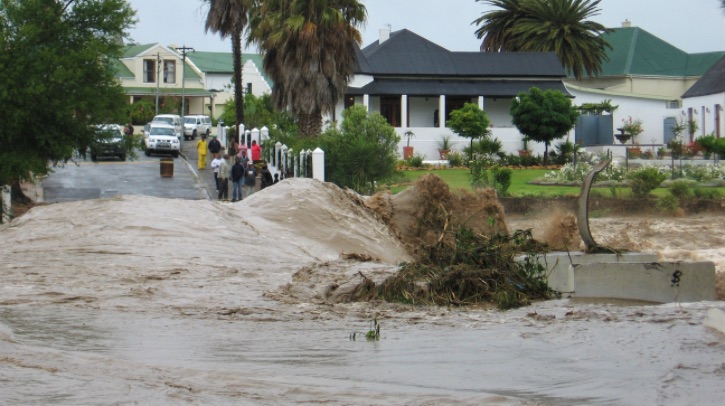
The National Institute for Health and Care Research (NIHR) has awarded more than £2m (US$2.6m) to the Warning system for Extreme weather events, Awareness Technology for Healthcare, Equitable delivery, and Resilience (WEATHER) project.
The project is a multi-partner collaboration involving the University of the West of Scotland (UWS), the University of KwaZulu-Natal (UKZN), the Royal College of Surgeons in Ireland (RCSI) Faculty of Nursing and Midwifery and the University of Portsmouth. The partners plan to develop an early warning system for extreme weather events in South Africa that will empower vulnerable communities and healthcare systems in response to the impacts of flooding and associated health risks.
AI in weather prediction
Using artificial intelligence (AI), the WEATHER project will develop a comprehensive warning system tailored to the needs of affected communities. Geospatial technologies will collate weather and climate data while AI algorithms will analyze weather, climate and health data to identify patterns and trends which enable more accurate predictions of flooding and associated health risks. AI-powered tools will continuously monitor and assess flood risks in real time, enabling swift interventions to minimize disease outbreaks. Warnings will be shared through a mobile app providing more detailed information, maps and resources tailored to specific locations and needs and through SMS text messages, ensuring widespread reach even in areas with limited internet access.
AI can personalize and tailor alerts through the mobile platform, ensuring critical information reaches the right people at the right time. Integration of AI throughout the project is designed to create a more accurate, efficient and far-reaching warning system, empowering communities to become more resilient in the face of extreme weather events.
The system will use the existing mobile phone infrastructure in communities – this means warnings will be disseminated through SMS text messages, ensuring widespread reach even in areas with limited internet access. There will also be mobile applications which will provide more detailed information, maps and resources tailored to specific locations and needs.
Project intentions
Professor Fiona Henriquez, co-investigator on the WEATHER project and associate dean of research and innovation at the School of Health and Life Sciences at UWS, said, “This is an important project which will support areas in eThekwini, South Africa, grappling with increasingly unpredictable weather patterns due to climate change, leaving communities exposed to floods, waterborne diseases and disrupted healthcare services. The WEATHER project has the potential to save lives and significantly improve health outcomes by providing timely and targeted warnings.”
The joint principal investigators (PIs) on the project, Professor Mary Lynch, professor and executive vice dean for research in faculty of Nursing and Midwifery at UWS and RCSI, and Professor Saloshni Naidoo, UKZN, developed the collaboration.
The project focuses on two vulnerable districts in KwaZulu-Natal, eThekwini and Ugu, collaborating with local communities and healthcare providers throughout the research process. This is to ensure the developed system is culturally sensitive, context-specific and addresses the unique needs of the target population. The University of KwaZulu-Natal will bring expertise and local context to the project through its established connections with communities and healthcare providers.
Professor David Ndzi, head of the University of Portsmouth’s School of Electrical and Mechanical Engineering, said, “WEATHER embodies the power of collaboration between technology and human expertise. AI tools amplify our analysis and prediction capabilities, but it’s the partnership with local communities that will truly optimize the system and ensure it makes a lasting difference.”
Professor Naidoo from UKZN remarked, “A successful WEATHER project would not only benefit our communities and strengthen the health system but also serve as a valuable model for other regions facing similar climate-related risks, potentially contributing to broader improvements across South Africa and in other low- and middle-income countries.”
Professor Mohammed Zeeshan Shakir at the School of Computing, Engineering and Physical Sciences at UWS said, “We can’t change the weather, but we can change how we respond to it.”
Professor Lynch added, “Thanks to this support, we can translate innovative ideas into tangible solutions, ultimately empowering people on the frontlines of climate change to face extreme weather events with greater preparedness and resilience.”
In related news, EUMETSAT recently hosted its biennial conference for African weather and climate experts in Cotonou, Benin, in which the executives discussed the continent’s access to new and more precise meteorological satellite data and the data’s use for early warnings of severe weather events. Click here to read the full story.