


Close Menu
Meteorological Technology International
  • News
    • A-E
      • Agriculture
      • Automated Weather Stations
      • Aviation
      • Climate Measurement
      • Data
      • Developing Countries
      • Digital Applications
      • Early Warning Systems
      • Extreme Weather
    • G-P
      • Hydrology
      • Lidar
      • Lightning Detection
      • New Appointments
      • Nowcasting
      • Numerical Weather Prediction
      • Polar Weather
    • R-S
      • Radar
      • Rainfall
      • Remote Sensing
      • Renewable Energy
      • Satellites
      • Solar
      • Space Weather
      • Supercomputers
    • T-Z
      • Training
      • Transport
      • Weather Instruments
      • Wind
      • World Meteorological Organization
      • Meteorological Technology World Expo
  • Features
  • Online Magazines
    • January 2026
    • April 2025
    • January 2025
    • September 2024
    • April 2024
    • Archive Issues
    • Subscribe Free!
  • Opinion
  • Videos
  • Supplier Spotlight
  • Expo
LinkedIn X (Twitter) Facebook
  • Sign-up for Free Weekly E-Newsletter
  • Meet the Editors
  • Contact Us
  • Media Pack
LinkedIn Facebook
Subscribe
Meteorological Technology International
  • News
      • Agriculture
      • Automated Weather Stations
      • Aviation
      • Climate Measurement
      • Data
      • Developing Countries
      • Digital Applications
      • Early Warning Systems
      • Extreme Weather
      • Hydrology
      • Lidar
      • Lightning Detection
      • New Appointments
      • Nowcasting
      • Numerical Weather Prediction
      • Polar Weather
      • Radar
      • Rainfall
      • Remote Sensing
      • Renewable Energy
      • Satellites
      • Solar
      • Space Weather
      • Supercomputers
      • Training
      • Transport
      • Weather Instruments
      • Wind
      • World Meteorological Organization
      • Meteorological Technology World Expo
  • Features
  • Online Magazines
    1. January 2026
    2. September 2025
    3. April 2025
    4. January 2025
    5. September 2024
    6. April 2024
    7. January 2024
    8. September 2023
    9. April 2023
    10. Archive Issues
    11. Subscribe Free!
    Featured
    November 27, 2025

    In this Issue – January 2026

    By Hazel KingNovember 27, 2025
    Recent

    In this Issue – January 2026

    November 27, 2025

    In this Issue – September 2025

    August 11, 2025

    In this Issue – April 2025

    April 15, 2025
  • Opinion
  • Videos
  • Supplier Spotlight
  • Expo
Facebook LinkedIn
Subscribe
Meteorological Technology International
Climate Measurement

Summer of wildfires produces record carbon emissions for the Northern Hemisphere

Dan SymondsBy Dan SymondsSeptember 21, 20213 Mins Read
Share LinkedIn Facebook Twitter Email
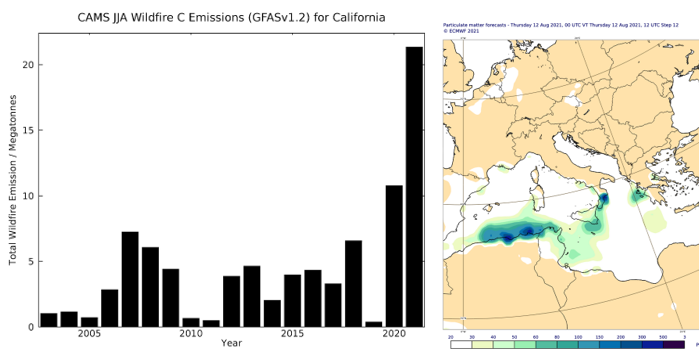
Left - CAMS estimated carbon emissions for California in the period June-July-August and the years 2003-2021. Right - Particulate matter forecasts for 12rd Aug shows high PM2.5 values over the Mediterranean basin. Credit: CAMS/ECMWF
Share
LinkedIn Facebook Twitter Email

Intense wildfires across North America, Siberia and the Mediterranean basin have led to new records in the Copernicus Atmosphere Monitoring Service (CAMS) data set, with the months of July and August seeing their highest global carbon emissions respectively.

CAMS, which is implemented by the European Centre for Medium-Range Weather Forecasts (ECMWF), reports that not only large parts of the Northern Hemisphere were affected during this year’s boreal fire season, but the number of fires, their persistence and intensity were “remarkable”.

As the boreal fire season draws to a close, CAMS scientists reveal that:

  • Dry conditions and heatwaves in the Mediterranean contributed to a wildfire hotspot with many intense and fast developing fires across the region, which created large amounts of smoke pollution.
  • July was a record month globally in the GFAS dataset with 1258.8 megatonnes of CO2  released. More than half of the carbon dioxide was attributed to fires in North America and Siberia.
  • According to GFAS data, August was a record month for fires as well, releasing an estimated 1384.6 megatonnes of CO2 globally into the atmosphere.
  • Arctic wildfires released 66 megatonnes of CO2 between June and August 2021.

Estimated CO2 emissions from wildfires in Russia as a whole from June to August amounted to 970 megatonnes, with the Sakha Republic and Chukotka accounting for 806 megatonnes.

Scientists at CAMS use satellite observations of active fires in near-real-time to estimate emissions and predict the impact of resulting air pollution. These observations provide a measure of the heat output of fires known as fire radiative power (FRP), which is related to the emission. CAMS estimates daily global fire emissions with its Global Fire Assimilation System (GFAS) using the FRP observations from the NASA MODIS satellite instruments. The estimated emissions of different atmospheric pollutants are used as a surface boundary condition in the CAMS forecast system, based on the ECMWF weather forecast system, which models the transportation and chemistry of atmospheric pollutants, to predict how global air quality will be affected up to five days ahead.

The boreal fire season typically lasts from May to October with peak activity taking place between July and August.

Mark Parrington, senior scientist and wildfire expert at CAMS, said, “Throughout the summer we have been monitoring wildfire activity across the Northern Hemisphere. What stood out as unusual were the number of fires, the size of the areas in which they were burning, their intensity and also their persistence. For example, the wildfires in Sakha Republic in northeastern Siberia have been burning since June and only started receding in late August although we have been observing some continuing fires in early September. It’s a similar story in North America, parts of Canada, the Pacific Northwest and California, which have been experiencing large wildfires since the end of June and beginning of July and are still ongoing.

“It is concerning that drier and hotter regional conditions – brought about by global warming – increase the flammability and fire risk of vegetation. This has led to very intense and fast-developing fires. While the local weather conditions play a role in the actual fire behavior, climate change is helping provide the ideal environments for wildfires. More fires around the world are anticipated in the coming weeks, too, as the fire season in the Amazon and South America continues to develop.” he added.

Previous ArticleWagtech Projects installs 40 automatic weather stations across Southern Africa
Next Article Tomorrow.io selects partners to develop radar-equipped weather satellites

Read Similar Stories

Space Weather

Northumbria University secures £4m to study Earth’s radiation belts

April 16, 20262 Mins Read
Extreme Weather

AI model improves real-time prediction of wildfire spread

April 16, 20263 Mins Read
Climate Measurement

Study identifies atmospheric trigger behind flash droughts in Puerto Rico

April 15, 20263 Mins Read
Latest News

Northumbria University secures £4m to study Earth’s radiation belts

April 16, 2026

AI model improves real-time prediction of wildfire spread

April 16, 2026

Study identifies atmospheric trigger behind flash droughts in Puerto Rico

April 15, 2026

Receive breaking stories and features in your inbox each week, for free


Enter your email address:


Supplier Spotlights
  • Senseca
Getting in Touch
  • Contact Us / Advertise
  • Meet the Editors
  • Media Pack
  • Free Weekly E-Newsletter
Our Social Channels
  • Facebook
  • LinkedIn
© 2026 UKi Media & Events a division of UKIP Media & Events Ltd
  • Cookie Policy
  • Privacy Policy
  • Terms and Conditions
  • Notice and Takedown Policy

Type above and press Enter to search. Press Esc to cancel.