


Close Menu
Meteorological Technology International
  • News
    • A-E
      • Agriculture
      • Automated Weather Stations
      • Aviation
      • Climate Measurement
      • Data
      • Developing Countries
      • Digital Applications
      • Early Warning Systems
      • Extreme Weather
    • G-P
      • Hydrology
      • Lidar
      • Lightning Detection
      • New Appointments
      • Nowcasting
      • Numerical Weather Prediction
      • Polar Weather
    • R-S
      • Radar
      • Rainfall
      • Remote Sensing
      • Renewable Energy
      • Satellites
      • Solar
      • Space Weather
      • Supercomputers
    • T-Z
      • Training
      • Transport
      • Weather Instruments
      • Wind
      • World Meteorological Organization
      • Meteorological Technology World Expo
  • Features
  • Online Magazines
    • January 2026
    • April 2025
    • January 2025
    • September 2024
    • April 2024
    • Archive Issues
    • Subscribe Free!
  • Opinion
  • Videos
  • Supplier Spotlight
  • Expo
LinkedIn X (Twitter) Facebook
  • Sign-up for Free Weekly E-Newsletter
  • Meet the Editors
  • Contact Us
  • Media Pack
LinkedIn Facebook
Subscribe
Meteorological Technology International
  • News
      • Agriculture
      • Automated Weather Stations
      • Aviation
      • Climate Measurement
      • Data
      • Developing Countries
      • Digital Applications
      • Early Warning Systems
      • Extreme Weather
      • Hydrology
      • Lidar
      • Lightning Detection
      • New Appointments
      • Nowcasting
      • Numerical Weather Prediction
      • Polar Weather
      • Radar
      • Rainfall
      • Remote Sensing
      • Renewable Energy
      • Satellites
      • Solar
      • Space Weather
      • Supercomputers
      • Training
      • Transport
      • Weather Instruments
      • Wind
      • World Meteorological Organization
      • Meteorological Technology World Expo
  • Features
  • Online Magazines
    1. January 2026
    2. September 2025
    3. April 2025
    4. January 2025
    5. September 2024
    6. April 2024
    7. January 2024
    8. September 2023
    9. April 2023
    10. Archive Issues
    11. Subscribe Free!
    Featured
    November 27, 2025

    In this Issue – January 2026

    By Hazel KingNovember 27, 2025
    Recent

    In this Issue – January 2026

    November 27, 2025

    In this Issue – September 2025

    August 11, 2025

    In this Issue – April 2025

    April 15, 2025
  • Opinion
  • Videos
  • Supplier Spotlight
  • Expo
Facebook LinkedIn
Subscribe
Meteorological Technology International
Climate Measurement

Ocean glaciers are melting slower than those in lakes or on land, University of Washington finds

Elizabeth BakerBy Elizabeth BakerAugust 15, 20225 Mins Read
Share LinkedIn Facebook Twitter Email
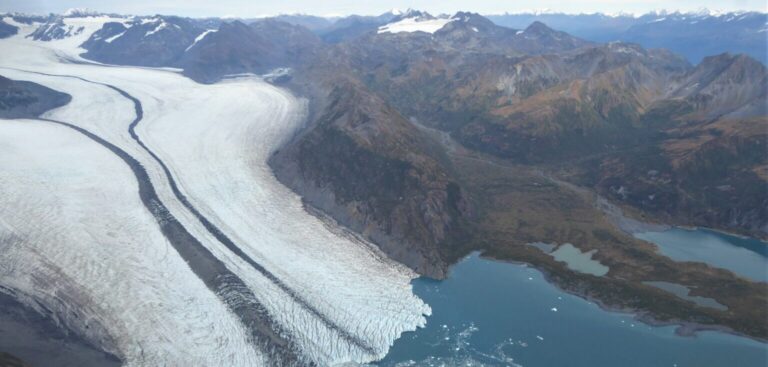
Almost half of Kenai Fjords National Park is covered by glacial ice. Glaciers play an important role in sculpting the park’s landscape, including Bear Glacier, shown here. The lagoon at the glacier’s base is growing as the glacier retreats (credit: US National Park Service/Deborah Kurtz)
Share
LinkedIn Facebook Twitter Email

A study by the University of Washington (UW) in Seattle, Washington State, and the US National Park Service has measured 38 years of change for glaciers in Kenai Fjords National Park in Alaska, and has found that glaciers terminating in the ocean are melting slower than those in lakes or on land.

The 271,000ha park hosts various glaciers; some terminate in the ocean, others in lakes or on land. The study, published on August 5 in the Journal of Glaciology, found that 13 of the 19 glaciers studied showed substantial retreat, four were relatively stable and two have advanced.
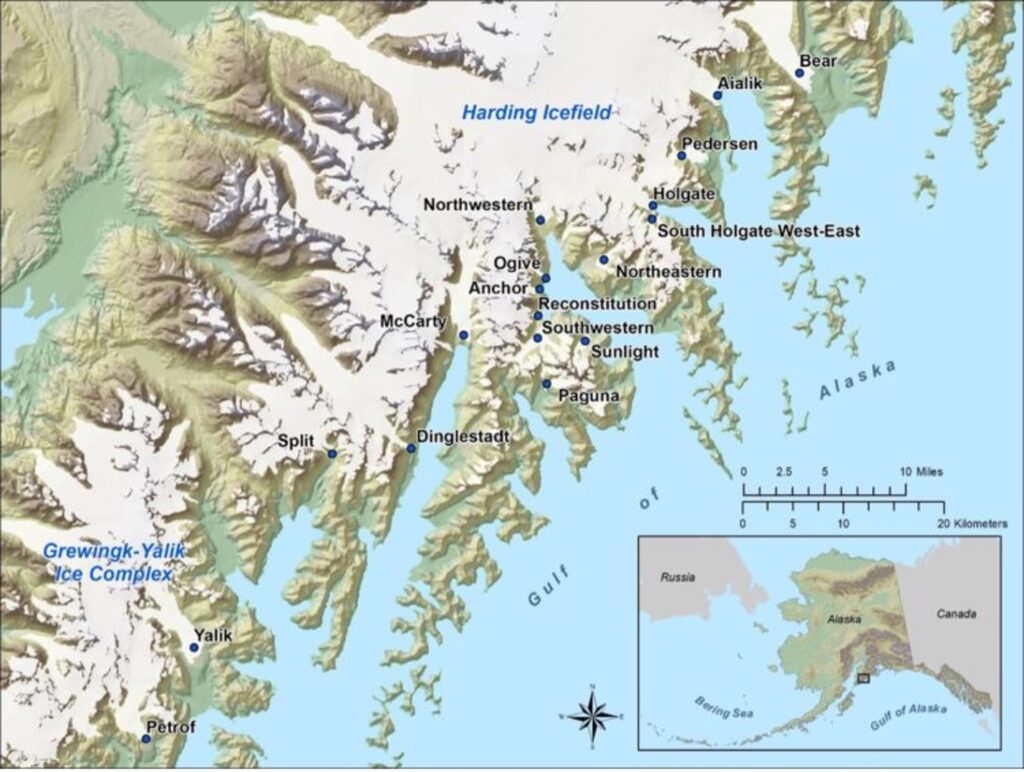
Kenai Fjords National Park is on Alaska’s Kenai Peninsula and is dominated by two major icefields. The 19 glaciers included in the study are shown as blue dots. While Alaska glaciers are just a small fraction of the planet’s glacial ice, they are losing ice faster than any other glacierized region outside of Antarctica and Greenland (credit: US National Park Service/Deborah Kurtz)

The data showed that lake-terminating glaciers, which include the Bear Glacier and Pedersen Glacier, are retreating the fastest. Bear Glacier retreated by 5km between 1984 and 2021, and Pedersen Glacier retreated by 3.2km during the same period.

Taryn Black, a UW doctoral student in the Department of Earth and Space Sciences and lead author of the study, said, “In Alaska, much glacier retreat is being driven by climate change. These glaciers are at a really low elevation. It’s possibly causing them to get more rain rather than snow in the winter in addition to warming temperatures, which is consistent with other climate studies in this region.”

One unexpected finding was that Holgate Glacier, which as a tidewater glacier terminates at the ocean, has advanced in recent years. Local boat operators had reported seeing newly exposed land near the glacier’s edge in 2020. However, the new analysis shows that the overall glacier has been advancing for about five years and appears to go through regular cycles of advance and retreat. The edges of most of the other tidewater glaciers were relatively stable over the study period.
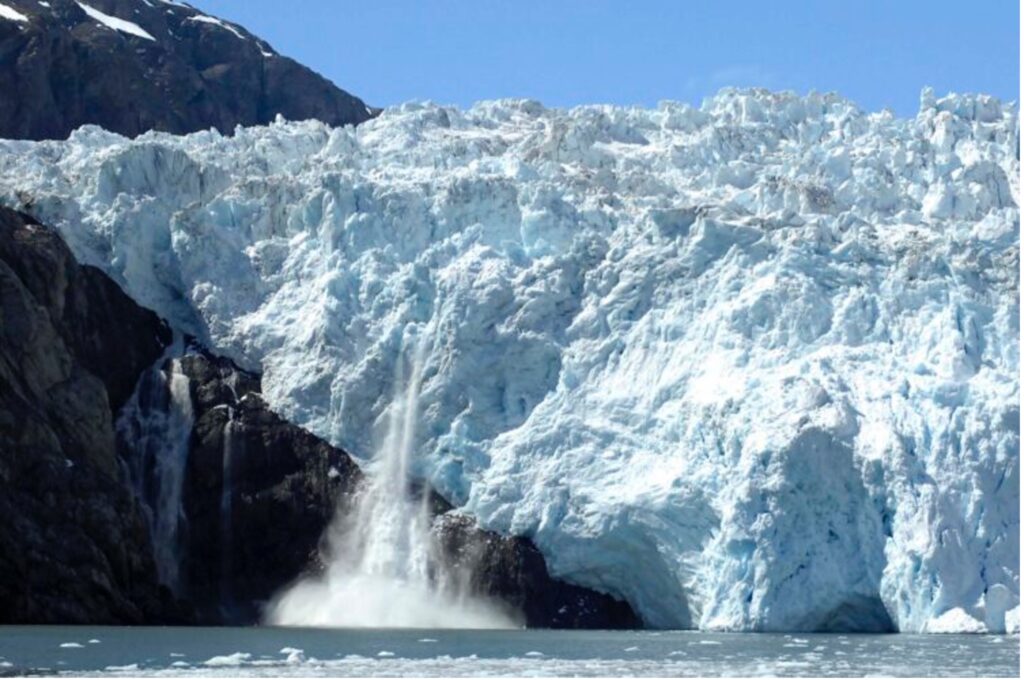
Holgate Glacier, shown here in June 2009, terminates on the coast and is a popular kayaking destination, especially in summer when the ice is calving (credit: US National Park Service)

The six land-terminating glaciers all showed an intermediate response, with most retreating, especially in summer months, but at a slower rate than the lake-terminating glaciers. The only other glacier that advanced during the study period was the land-terminating Paguna Glacier, which is covered in rock debris from a landslide caused by the 1964 Alaska earthquake. This debris insulates the glacier surface from melting.

To make the calculations, Black used 38 years of images captured by satellites in autumn and spring to trace outlines for each of the 19 glaciers – a total of about 600 outlines. She visually inspected each image to map the position of the glacier’s edge. Black used a similar approach in recent research to calculate the rate of retreat of marine-terminating glaciers in west Greenland.
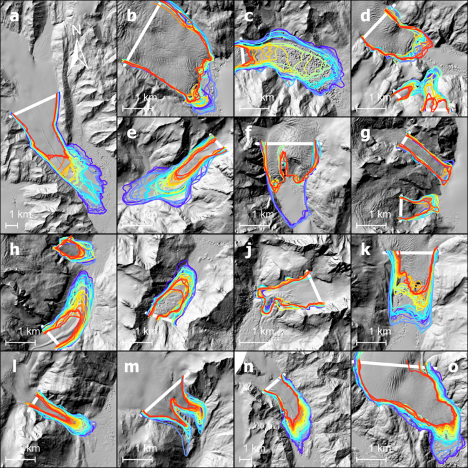
These colored outlines show the edges mapped for each of the 19 glaciers that were studied in Kenai Fjords National Park. Color scale ranges from purple for 1984, the earliest year in the satellite images, to red for 2021, the most recent year. Thirteen of the 19 glaciers showed substantial retreat (credit: Taryn Black/University of Washington)

According to the university, the new data for Alaska provides a baseline to study how climate change – including warmer air temperatures, as well as changes in both the types and amount of precipitation – will continue to affect these glaciers. All the glaciers in the study are considered maritime glaciers because they are subject to the warm, wet maritime climate.

For park managers, these results are expected to help to quantify the changes that have been and will continue to occur for the glaciers and their immediate environments.

Deborah Kurtz, physical science program manager at the US National Park Service in Seward, Alaska, and co-author of the study, said, “We can’t manage our lands well if we don’t understand the habitats and processes occurring on them. Interpretation and education are also an important part of the National Park Service mission. This data will allow us to provide scientists and visitors with more details of the changes occurring at each specific glacier, helping everyone to better understand and appreciate the rate of landscape change we are experiencing in this region.”

This study was done as part of an internship originally intended to take place at Kenai Fjords National Park. Black instead did the research remotely from Seattle and visited local glaciers at Mount Rainier. Part of this research was funded by the National Park Service’s Future Park Leaders program, a partnership between the Ecological Society of America and the US National Park Service.

Previous ArticleIn this Issue – September 2022
Next Article Heat index underestimates perceived temperature, finds UC Berkeley

Read Similar Stories

Climate Measurement

Study identifies atmospheric trigger behind flash droughts in Puerto Rico

April 15, 20263 Mins Read
Satellites

AI tool uses weather satellite data to map ocean currents in near real time

April 14, 20263 Mins Read
Climate Measurement

New tool speeds up climate model evaluation

April 13, 20262 Mins Read
Latest News

Northumbria University secures £4m to study Earth’s radiation belts

April 16, 2026

AI model improves real-time prediction of wildfire spread

April 16, 2026

Study identifies atmospheric trigger behind flash droughts in Puerto Rico

April 15, 2026

Receive breaking stories and features in your inbox each week, for free


Enter your email address:


Supplier Spotlights
  • ROTRONIC AG
Getting in Touch
  • Contact Us / Advertise
  • Meet the Editors
  • Media Pack
  • Free Weekly E-Newsletter
Our Social Channels
  • Facebook
  • LinkedIn
© 2026 UKi Media & Events a division of UKIP Media & Events Ltd
  • Cookie Policy
  • Privacy Policy
  • Terms and Conditions
  • Notice and Takedown Policy

Type above and press Enter to search. Press Esc to cancel.