


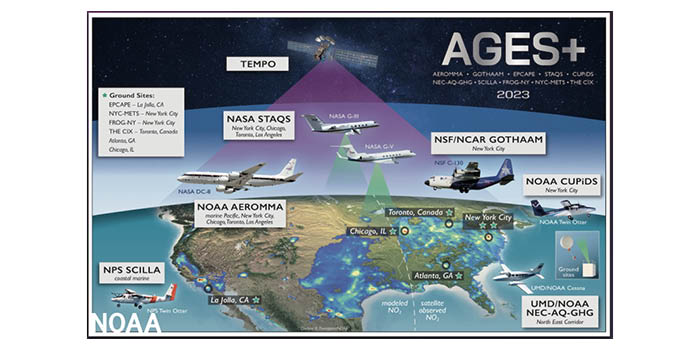
Scientists from the US National Oceanic and Atmospheric Administration (NOAA), NASA and 21 universities from three countries are deploying state-of-the-art instruments in multiple, coordinated research campaigns to investigate how air pollution sources have shifted over recent decades.
Rick Spinrad, NOAA administrator, said, “This is an unprecedented scientific investigation, in scope, scale and sophistication, of an ongoing public health threat that kills people every year. No one agency or university could do anything like this alone.”
Using multiple satellites, seven research aircraft, vehicles and dozens of stationary installations, scientists will measure air pollution from sources that include transportation, industrial facilities, agriculture, wildfires and consumer products such as paint, pesticides and perfumes. The data will be analyzed and run through sophisticated chemical and weather models by scientists and the US Environmental Protection Agency (EPA) in an effort to improve air pollution forecasts. Findings will be shared with state and local environmental officials to inform decisions about the most effective ways to reduce air pollution.
The data will also be used to evaluate the first observations made by NASA’s TEMPO instrument — the first geostationary space-borne sensor to continuously measure air pollution across North America. Lessons learned will aid the development of the new GeoXO satellites being jointly developed by NOAA and NASA.
Probing the causes of persistent pollution
EPA, which sets national air quality regulations, currently lists about 200 US counties as failing to meet the eight-hour ozone standard established in 2015. Sixty-nine counties are failing to meet the standard for fine particulates, or PM2.5, set in 2006. After decades of decline in ground-level ozone and fine particulate matter in the USA, downward trends have slowed in recent years.
Scientists from four NOAA research labs, led by the Chemical Sciences Laboratory (CSL), along with NOAA satellite scientists and research pilots, are leading three of the research projects. The largest, AEROMMA, has NOAA scientists and collaborators operating 30 specialized instruments on board NASA’s DC-8 flying laboratory, collecting a variety of chemical measurements over highly populated cities, including New York City, Chicago, Toronto and Los Angeles.
“In order to make progress on reducing air pollution that negatively affects millions of Americans, we need to have a better understanding of the current sources of pollutants and what happens to these pollutants once they are in the atmosphere,” said CSL scientist Carsten Warneke, one of the AEROMMA project’s mission scientists.
For decades, fossil fuel emissions were the primary source of urban volatile organic compounds (VOCs), which along with nitrogen oxides, (NOx), act as precursors to both ground-level ozone and particulate pollution. As VOCs from the transportation sector have declined, recent NOAA research shows that consumer products derived from fossil fuels may now contribute as much as 50% of total petrochemical VOC emissions in densely populated urban cities. These may not be properly accounted for in emission inventories or considered in air quality management strategies.
The campaigns may also have an opportunity to investigate another emerging air pollution source: wildfire smoke that has blanketed the Midwest and East Coast states this summer.
Collecting data
NASA researchers are also deploying two of their Gulfstream research aircraft with the DC-8, mapping air quality and methane from high altitudes over the five cities while the DC-8 collects measurements at lower altitudes. Similar to the other projects, data collected by NASA’s STAQS mission will be compared to TEMPO’s high-resolution estimates of trace gas and aerosols, as well as with emission inventories and atmospheric processes.
“NASA is excited to partner with NOAA and EPA during these field campaigns to learn how best to use the TEMPO satellite to observe hourly changes in air quality at the neighborhood scale over North America,” said Barry Lefer, NASA’s program scientist for tropospheric composition.
A concurrent NOAA research mission, CUPiDS, will use NOAA’s Twin Otter research plane to zero in on the meteorology and dynamics of the atmosphere that creates and transports pollutants from the New York metro area downwind over Southern New England. Another element pairs a University of Maryland instrumented Cessna aircraft and a NOAA-instrumented SUV making simultaneous measurements in the air and at the surface to better understand the vertical distribution of air pollution and greenhouse gas emissions in the Northeast corridor from DC-Baltimore up to New York City and Long Island Sound.
On the ground, researchers from Yale University, Aerodyne Research Inc. and other NOAA-funded collaborators will be taking measurements from a rooftop site at the The City College of New York campus, downwind in Guilford, Connecticut, from a 62m research tower on Long Island, in coordination with the DC-8 and Twin Otter flights. NOAA’s Climate Program Office is providing major funding for these and other affiliated studies.
“This regional network of ground sites has enormous potential to help us understand urban and downwind air pollution — not just today but under a continually changing climate,” said Yale Professor Drew Gentner, who is coordinating ground sites in New York and Connecticut.
In Manhattan, scientists will be carrying air pollution sensors in backpacks in a NOAA pilot project to investigate surface ozone and PM2.5 in underserved neighborhoods in New York City, where pollution directly impacts human health, especially during heatwave events.
“The large number of participants, measurements, the variety of platforms involved, and the way they are working together in a highly choreographed and coordinated way is unique,” said CSL director David Fahey. “Our goal is a comprehensive view of air pollution spanning the US to improve forecasts of urban and regional air quality and advance the health of our nation.”