



The World Meteorological Organization (WMO) has released a report that points out the potential for low-cost sensor systems to assess levels of air pollution and identify sources, and support air quality strategies to reduce them.
The report, Integrating Low-Cost Sensor Systems and Networks to Enhance Air Quality Applications, was produced by WMO’s Global Atmosphere Watch network in collaboration with the UN Environment Programme (UNEP), International Global Atmospheric Chemistry project (IGAC) and international experts on technical and application areas. It was released to coincide with the WMO Executive Council meeting, which has a focus on transforming science and practical services for society.
Low-cost sensor systems for air quality monitoring
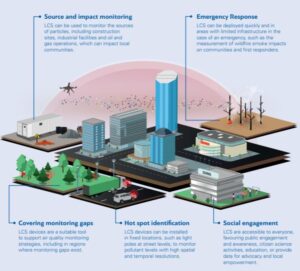
In the report, the researchers highlight that low-cost sensor systems (LCS) represent a key tool for filling gaps in existing global and local air quality monitoring networks and contributing information for policy-relevant air quality strategies.
In recent years, wide-scale deployments of LCS have been made in low- and middle-income countries, where they often provide air quality information in regions lacking the more traditional (and more expensive) reference grade monitors. In high-income countries, they supplement existing reference grade monitors with more localized near-real-time air quality information – for instance, to monitor fire and smoke or vehicle emissions on busy roads.
“Air quality forecasting involving low-cost sensors is an increasingly important field due to its potential to support widespread monitoring and early warning systems, particularly in areas lacking more traditional monitors,” said Sara Basart, WMO scientific officer and one of the report’s authors. “Air quality forecasting is important to support effective decision-making to manage air quality impacts, especially in terms of human health. They are an important additional tool which can be harnessed at the community level to make a real difference in people’s lives.”
“Life begins and is sustained with breath, but too many around the world are suffering health problems and death due to breathing dirty air,” added Richard Munang, head of global environment monitoring systems and early warning for environment unit at UNEP. “Data-driven policy action toward combating air pollution is critical for efforts to improve global air quality – the more tools we have to support this, the greater our chances of recreating healthy environments for all life on Earth.”
“We had more than 30 contributors from many different countries,” revealed Carl Malings, lead coordinating author of the report. “We were able to get a broad spectrum of different opinions and experiences worldwide and synthesize them into a report which really summarizes the best practices for air quality applications from many different experiences around the world.”
The effects of air pollution led to an estimated seven million deaths every year, according to WHO. The organization also pointed to mounting evidence that links ambient and household air pollution to various health outcomes such as non-communicable diseases including respiratory, cardiovascular and pulmonary diseases, cancer, low birth weight, diabetes, cognitive impairment and mental health impacts.
Network level
An LCS contains one or more sensing element together with hardware and software for control, power supply, data management and weatherproofing, constituting a complete system capable of collecting atmospheric composition data.
The ‘low cost’ of LCS refers to their per-unit capital cost in relation to more traditional reference grade monitors. However, technical trade-offs that enable this lower cost usually also limit data quality, selectivity, sensitivity to low concentrations, robustness under high concentrations and/or operational lifetime.
In order to overcome these limitations of individual LCS, the report examines the use of LCS at a network level and in conjunction with other data sources, such as air quality models and satellites. It intends to provide a valuable foundation by summarizing recommendations and best practices for those seeking to make effective use of LCS networks alongside other data sources to improve understanding and management of air quality.
For example, the increased availability of locally and even personally specific air quality information enabled by LCS has led to their increased use for health studies. Also, multipollutant LCS are useful for determining vehicle emission factors. LCS networks covering both roadside sites and background locations can help identify the relative contribution of traffic to local air pollution.
These recommendations and others are supported by a survey of the available academic literature, as well as practical case study examples.
In related news, the annual World Meteorological Organization (WMO) Executive Council meeting recently began discussions on a detailed roadmap to provide early warnings against natural hazards and an implementation plan for a new Global Greenhouse Gas Watch initiative. Click here to read the full story