


Close Menu
Meteorological Technology International
  • News
    • A-E
      • Agriculture
      • Automated Weather Stations
      • Aviation
      • Climate Measurement
      • Data
      • Developing Countries
      • Digital Applications
      • Early Warning Systems
      • Extreme Weather
    • G-P
      • Hydrology
      • Lidar
      • Lightning Detection
      • New Appointments
      • Nowcasting
      • Numerical Weather Prediction
      • Polar Weather
    • R-S
      • Radar
      • Rainfall
      • Remote Sensing
      • Renewable Energy
      • Satellites
      • Solar
      • Space Weather
      • Supercomputers
    • T-Z
      • Training
      • Transport
      • Weather Instruments
      • Wind
      • World Meteorological Organization
      • Meteorological Technology World Expo
  • Features
  • Online Magazines
    • January 2026
    • April 2025
    • January 2025
    • September 2024
    • April 2024
    • Archive Issues
    • Subscribe Free!
  • Opinion
  • Videos
  • Supplier Spotlight
  • Expo
LinkedIn X (Twitter) Facebook
  • Sign-up for Free Weekly E-Newsletter
  • Meet the Editors
  • Contact Us
  • Media Pack
LinkedIn Facebook
Subscribe
Meteorological Technology International
  • News
      • Agriculture
      • Automated Weather Stations
      • Aviation
      • Climate Measurement
      • Data
      • Developing Countries
      • Digital Applications
      • Early Warning Systems
      • Extreme Weather
      • Hydrology
      • Lidar
      • Lightning Detection
      • New Appointments
      • Nowcasting
      • Numerical Weather Prediction
      • Polar Weather
      • Radar
      • Rainfall
      • Remote Sensing
      • Renewable Energy
      • Satellites
      • Solar
      • Space Weather
      • Supercomputers
      • Training
      • Transport
      • Weather Instruments
      • Wind
      • World Meteorological Organization
      • Meteorological Technology World Expo
  • Features
  • Online Magazines
    1. January 2026
    2. September 2025
    3. April 2025
    4. January 2025
    5. September 2024
    6. April 2024
    7. January 2024
    8. September 2023
    9. April 2023
    10. Archive Issues
    11. Subscribe Free!
    Featured
    November 27, 2025

    In this Issue – January 2026

    By Hazel KingNovember 27, 2025
    Recent

    In this Issue – January 2026

    November 27, 2025

    In this Issue – September 2025

    August 11, 2025

    In this Issue – April 2025

    April 15, 2025
  • Opinion
  • Videos
  • Supplier Spotlight
  • Expo
Facebook LinkedIn
Subscribe
Meteorological Technology International
Polar Weather

Japan’s National Institute of Polar Research discovers link between wave height and Arctic ice clouds

Elizabeth BakerBy Elizabeth BakerSeptember 23, 20213 Mins Read
Share LinkedIn Facebook Twitter Email
Credit - Japan’s National Institute of Polar Research
Share
LinkedIn Facebook Twitter Email

A new report from Japan’s National Institute of Polar Research (NIPR) has discovered an important meteorological link between high waves and ice clouds in the Arctic.

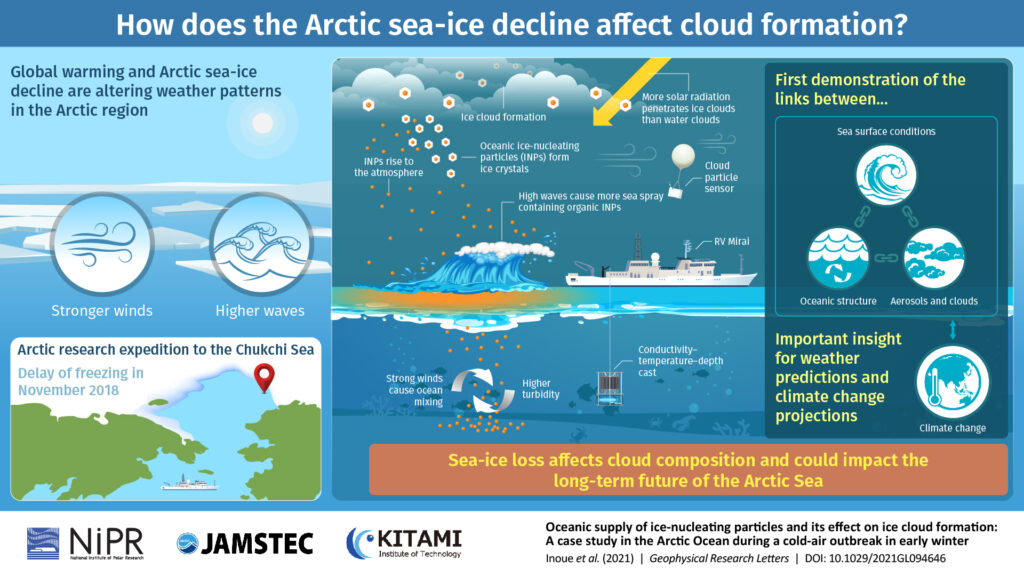
Scientists analyzed data from a 2018 research expedition into the Chukchi Sea by NIPR affiliate Dr. Jun Inoue, and set about simultaneously linking oceanic structure, sea surface conditions and aerosol and cloud characteristics to emphasize the role of ‘ice-nucleating particles’ (INPs).

Inoue’s field data from the November 2018 expedition to the Chukchi Sea in the Arctic region was gathered aboard RV Mirai, a Japanese research vessel. Previous studies in the area had revealed that the sea-ice decline in the Arctic led to more frequent active weather systems, stronger wind and taller waves. The research team suspected that these factors could affect cloud formation and composition because crashing waves and strong winds can cause organic particles on the sea surface to become dispersed through the atmosphere in the form of sea spray. Once these suspended organic particles reach a high enough altitude, they act as ‘seeds’ that facilitate the formation of ice crystals, earning them the name of INPs. These ice crystals keep growing by freezing the surrounding water droplets, thereby forming what’s known as ice clouds.

To prove this hypothesis, Inoue and his crew periodically deployed various measurement instruments at key locations in the Chukchi Sea over the course of 12 days. Cloud particle sensors were balloon-launched from the ship to analyze the phase of clouds, ambient aerosols were regularly sampled on board for chemical analysis, and wave height and wind speed measurements were constantly made. Moreover, the researchers conducted turbidity measurements from different depths to clarify the relationship between weather, oceanic conditions and organic matter.

After analyzing all the gathered data, the scientists managed to paint a clearer, evidence-supported view of the situation. Dr Inoue explained that the “Chukchi Sea is relatively shallow, with a mean depth of only 40m. There, a mixed ocean layer develops and taps into the seafloor, which provides a reservoir of INPs that get lifted by turbulent kinetic energy and active biology. Sea spray induced by strong winds and high waves brings these INPs to the atmosphere, promoting the formation of ice clouds”.

According to Inoue, the insight gained from this study could be critical in accurately predicting the effects of global warming on the Arctic. Ice clouds reflect much less shortwave solar radiation than water clouds, and thus the phase of clouds greatly affects the surface heat budget of the polar regions. They may also increase the amount of snowfall, which in turn positively affects sea-ice formation.

“Understanding the relationship between cloud formation and the new sea state originating from the recent Arctic sea-ice decline is critical for skillful weather and sea-ice forecasts, as well as future climate projections,” said Inoue.

Some of the most well-known and feared aspects of climate change are its potential effects on weather patterns and how this could accelerate the melting of natural ice. Research has already proven that the area of sea-ice in the Arctic is rapidly declining, and that temperature and moisture content across the Arctic have changed substantially. Understanding exactly how these changes affect cloud formation in the region is very challenging, and cloud composition and phase are important aspects to consider in predictive numerical models.

Previous ArticleTomorrow.io selects partners to develop radar-equipped weather satellites
Next Article Biral appoints Henry Olver as new lead engineer

Read Similar Stories

Climate Measurement

Study identifies atmospheric trigger behind flash droughts in Puerto Rico

April 15, 20263 Mins Read
Satellites

AI tool uses weather satellite data to map ocean currents in near real time

April 14, 20263 Mins Read
Climate Measurement

New tool speeds up climate model evaluation

April 13, 20262 Mins Read
Latest News

Northumbria University secures £4m to study Earth’s radiation belts

April 16, 2026

AI model improves real-time prediction of wildfire spread

April 16, 2026

Study identifies atmospheric trigger behind flash droughts in Puerto Rico

April 15, 2026

Receive breaking stories and features in your inbox each week, for free


Enter your email address:


Supplier Spotlights
  • Baron
Getting in Touch
  • Contact Us / Advertise
  • Meet the Editors
  • Media Pack
  • Free Weekly E-Newsletter
Our Social Channels
  • Facebook
  • LinkedIn
© 2026 UKi Media & Events a division of UKIP Media & Events Ltd
  • Cookie Policy
  • Privacy Policy
  • Terms and Conditions
  • Notice and Takedown Policy

Type above and press Enter to search. Press Esc to cancel.