


CATRINE, an EU-funded three-year project coordinated by ECMWF, will be launched in January 2024 to improve the numerical aspects of the transportation of atmospheric tracers – with an emphasis on long-lived greenhouse gases. It is to support an operational anthropogenic greenhouse gas emissions monitoring and verification support capacity (CO2MVS).
The project’s results will be in time for CO2MVS, which will come into operation in 2026 as part of the EU’s Copernicus Atmosphere Monitoring Service (CAMS) implemented by ECMWF. The aim is to improve the methods used to represent the transportation of atmospheric tracers through the wind. CATRINE will focus on improving mass conservation in ECMWF’s Integrated Forecasting System (IFS) and identifying other systematic errors in the various atmospheric transportation and mixing processes.
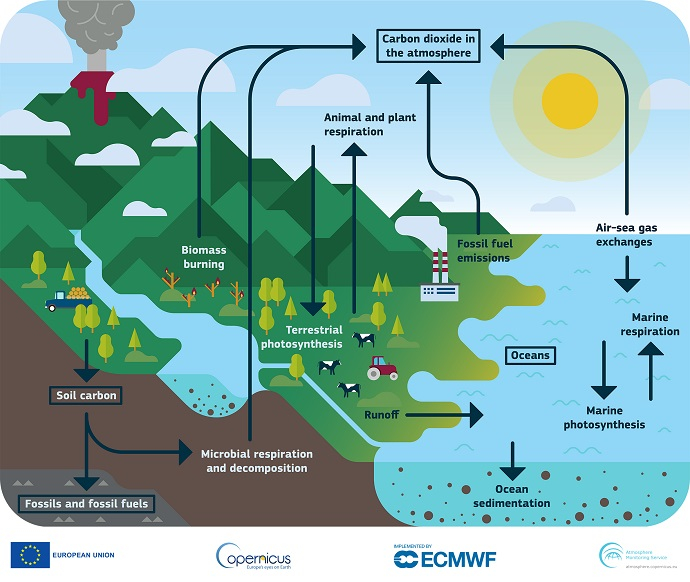
According to ECMWF, the goal of CO2MVS – to monitor the emissions of greenhouse gases caused by humans – is not very well supported by direct observations of the emissions. This is why the organization has highlighted the need for accurate information from different components of the Earth system. This includes observations from the surface and space, knowledge of the chemistry in the atmosphere and, crucially, an understanding of the transportation of greenhouse gases and other tracers in the atmosphere.
ECMWF pointed out that the two main long-lived greenhouse gases to which humans contribute are carbon dioxide (CO2) and methane (CH4). However, while learning about the sources of human-caused emissions, it is possible to track other tracers that are co-emitted. CATRINE will look at the atmospheric transportation of tracers.
“Knowledge of transportation allows us to study how tracers move and mix, and to estimate the surface fluxes of the tracers by tracing back the signals in the atmospheric CO2 and CH4 to the emissions and surface fluxes from the land and the oceans,” said Anna Agustí-Panareda, co-coordinator of CATRINE and an ECMWF scientist. The approach of estimating emissions and natural surface fluxes from atmospheric observations is known as atmospheric inversion modeling and is at the core of the CO2MVS. For this approach to work, the tracer transportation model needs to be accurate.
Agustí-Panareda added, “Currently we don’t know how well the IFS and other tracer transportation models used for atmospheric inversions perform in terms of the transportation of long-lived tracers such as CO2 and CH4. We want to establish whether there are any systematic errors, quantify those and better understand their origin.”
The first task is to assess the quality of the transportation of tracers in the IFS and other tracer transportation models used operationally in CAMS and other European operational centers. The next step will be to improve it as required. In the IFS, part of the problem lies with the advection scheme, in other words, the numerical method used to solve the partial differential equations that model the transportation of momentum, heat and mass in an atmospheric model.
“The semi-Lagrangian scheme of the IFS is accurate and very efficient in forecasting the weather,” said Michail Diamantakis, co-coordinator of CATRINE and a scientist at ECMWF. “But it has one weakness: it does not accurately conserve the mass of transported air constituents locally or globally.”
One question, addressed by some consortium partners in CATRINE, will thus be whether the transportation of tracers can be adjusted to reduce local mass conservation problems and other transportation errors. This is particularly hard in the case of CO2 and CH4 because of local point-source emissions, e.g. from power stations, industrial facilities or leaks.
“It all depends on the signal-to-error ratio,” said Agustí-Panareda. “The CO2 signal, for example, is very small compared with the water vapor signal, which means that our requirements for accuracy are much higher.”
Another area of work, pursued by other consortium partners, concerns the simulation of plumes that are much smaller than what the IFS can represent. These plumes are highly variable in size and magnitude depending on the atmospheric conditions, and they can emanate from different heights depending also on the source type.
The goal is to use very high-resolution local models to simulate the transportation, mixing and chemistry in these small-scale plumes as accurately as possible, and to try to find ways to simplify these processes to include them in a large-scale model.
Once the model has been improved, it will have to be evaluated. “That will not be easy because it is difficult to separate emissions from transportation in observations,” Agustí-Panareda commented. “One way of doing this is based on the knowledge that different tracers have different emission errors, but they all have similar transportation errors.”
Observations will be used to detect where systematic errors are particularly large and what the sources of uncertainty are. One of the challenges to be addressed by some consortium members is to come up with metrics to quantify the transportation errors and identify the specific processes that need to be improved in the various tracer transportation models used in CATRINE.
The work carried out in CATRINE is also expected to have some benefits for numerical weather prediction. “A better tracer transportation scheme will also improve the transportation of moisture, which is very important for weather prediction,” said Diamantakis. “This is true especially as the grid spacing becomes smaller toward the km scale.”
In addition, numerical weather prediction increasingly relies on considering the Earth system as a whole. For example, the water fluxes from vegetation can affect the formation of clouds above. “We are trying to have a representation that is oriented more toward the Earth system, and to understand how important the coupling of different processes is,” said Agustí-Panareda. “That could be important for forecasts at longer timescales and at very high resolutions.”
CATRINE is coordinated by ECMWF and includes seven other research institutes: the French Alternative Energies and Atomic Energy Commission (CEA); Météo-France; Wageningen University in the Netherlands; the Karlsruhe Institute of Technology in Germany; Helsinki University in Finland; the University of Reims in France; and the University of Freiburg in Germany.
An outreach activity to other groups working on similar problems is also envisaged. “It will be good to have a community exchange on what works and what doesn’t work, so we’d like to have an intercomparison project,” concluded Agustí-Panareda. “There will first be an internal intercomparison, and then we’ll extend it to the international community.”
Read more of the latest climate measurement updates from the meteorological technology industry, here.