

Close Menu
Meteorological Technology International
  • News
    • A-E
      • Agriculture
      • Automated Weather Stations
      • Aviation
      • Climate Measurement
      • Data
      • Developing Countries
      • Digital Applications
      • Early Warning Systems
      • Extreme Weather
    • G-P
      • Hydrology
      • Lidar
      • Lightning Detection
      • New Appointments
      • Nowcasting
      • Numerical Weather Prediction
      • Polar Weather
    • R-S
      • Radar
      • Rainfall
      • Remote Sensing
      • Renewable Energy
      • Satellites
      • Solar
      • Space Weather
      • Supercomputers
    • T-Z
      • Training
      • Transport
      • Weather Instruments
      • Wind
      • World Meteorological Organization
      • Meteorological Technology World Expo
  • Features
  • Online Magazines
    • January 2026
    • April 2025
    • January 2025
    • September 2024
    • April 2024
    • Archive Issues
    • Subscribe Free!
  • Opinion
  • Videos
  • Supplier Spotlight
  • Expo
LinkedIn X (Twitter) Facebook
  • Sign-up for Free Weekly E-Newsletter
  • Meet the Editors
  • Contact Us
  • Media Pack
LinkedIn Facebook
Subscribe
Meteorological Technology International
  • News
      • Agriculture
      • Automated Weather Stations
      • Aviation
      • Climate Measurement
      • Data
      • Developing Countries
      • Digital Applications
      • Early Warning Systems
      • Extreme Weather
      • Hydrology
      • Lidar
      • Lightning Detection
      • New Appointments
      • Nowcasting
      • Numerical Weather Prediction
      • Polar Weather
      • Radar
      • Rainfall
      • Remote Sensing
      • Renewable Energy
      • Satellites
      • Solar
      • Space Weather
      • Supercomputers
      • Training
      • Transport
      • Weather Instruments
      • Wind
      • World Meteorological Organization
      • Meteorological Technology World Expo
  • Features
  • Online Magazines
    1. January 2026
    2. September 2025
    3. April 2025
    4. January 2025
    5. September 2024
    6. April 2024
    7. January 2024
    8. September 2023
    9. April 2023
    10. Archive Issues
    11. Subscribe Free!
    Featured
    November 27, 2025

    In this Issue – January 2026

    By Hazel KingNovember 27, 2025
    Recent

    In this Issue – January 2026

    November 27, 2025

    In this Issue – September 2025

    August 11, 2025

    In this Issue – April 2025

    April 15, 2025
  • Opinion
  • Videos
  • Supplier Spotlight
  • Expo
Facebook LinkedIn
Subscribe
Meteorological Technology International
Climate Measurement

Complex modeling that relies on supercomputers can now be done on a PC

Paul WillisBy Paul WillisFebruary 25, 20202 Mins Read
Share LinkedIn Facebook Twitter Email
Pic: Illia Horenko
Share
LinkedIn Facebook Twitter Email

European researchers say they have uncovered an algorithm capable of allowing complex forecasting currently only possible on supercomputers to be done on personal computers.

Researchers at Johannes Gutenberg University in Mainz, Germany, and Università della Svizzera italiana (USI) in Lugano, Switzerland, say their findings could pave the way for much more cost-effective weather forecasting.

Since the development of the first supercomputers in the early 1970s there has been a steady growth in processing power. This has helped improve the accuracy of forecast modeling, which relies on supercomputers to process the many variables associated with weather.

But with the development of artificial intelligence and machine-learning this growth in processing power may be coming to an end, say the researchers.

This is because the reasons why AI systems work are still largely not understood – the so-called ‘black box’ problem.

“We wanted to understand how artificial intelligence works and gain a better understanding of the connections involved,” said study co-author Professor Susanne Gerber, a specialist in bioinformatics at Mainz.

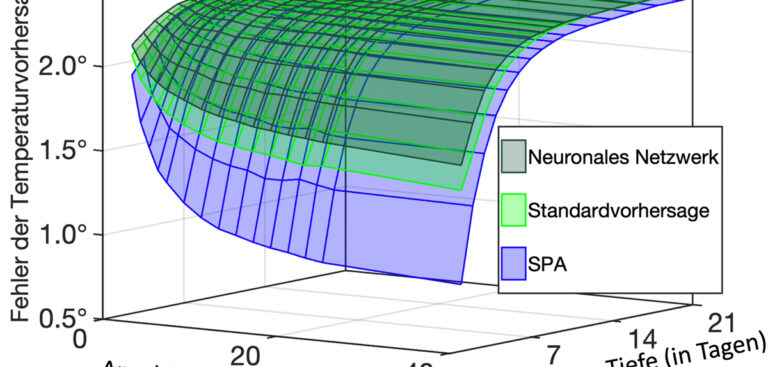
Alongside co-author Professor Illia Horenko, a computer expert at USI, Gerber developed a technique for carrying out very complex calculations at low cost and with high reliability. The technique uses a mathematically based concept called Scalable Probabilistic Approximation (SPA).

Using the SPA algorithm, Gerber and her team were able to make a data-based forecast of surface temperatures in Europe for the day ahead with “a prediction error of only 0.75°C,” she said.

The process can be done on an ordinary PC and has an error rate that is 40% better than the computer systems usually used by weather services, said Gerber.

Previous ArticleAmazon boss pledges US$10bn toward climate change fight
Next Article Air New Zealand aids NASA climate mission

Read Similar Stories

Climate Measurement

Study identifies atmospheric trigger behind flash droughts in Puerto Rico

April 15, 20263 Mins Read
Satellites

AI tool uses weather satellite data to map ocean currents in near real time

April 14, 20263 Mins Read
Climate Measurement

New tool speeds up climate model evaluation

April 13, 20262 Mins Read
Latest News

Northumbria University secures £4m to study Earth’s radiation belts

April 16, 2026

AI model improves real-time prediction of wildfire spread

April 16, 2026

Study identifies atmospheric trigger behind flash droughts in Puerto Rico

April 15, 2026

Receive breaking stories and features in your inbox each week, for free


Enter your email address:


Supplier Spotlights
  • Adolf Thies GmbH & Co. KG
Getting in Touch
  • Contact Us / Advertise
  • Meet the Editors
  • Media Pack
  • Free Weekly E-Newsletter
Our Social Channels
  • Facebook
  • LinkedIn
© 2026 UKi Media & Events a division of UKIP Media & Events Ltd
  • Cookie Policy
  • Privacy Policy
  • Terms and Conditions
  • Notice and Takedown Policy

Type above and press Enter to search. Press Esc to cancel.