


Close Menu
Meteorological Technology International
  • News
    • A-E
      • Agriculture
      • Automated Weather Stations
      • Aviation
      • Climate Measurement
      • Data
      • Developing Countries
      • Digital Applications
      • Early Warning Systems
      • Extreme Weather
    • G-P
      • Hydrology
      • Lidar
      • Lightning Detection
      • New Appointments
      • Nowcasting
      • Numerical Weather Prediction
      • Polar Weather
    • R-S
      • Radar
      • Rainfall
      • Remote Sensing
      • Renewable Energy
      • Satellites
      • Solar
      • Space Weather
      • Supercomputers
    • T-Z
      • Training
      • Transport
      • Weather Instruments
      • Wind
      • World Meteorological Organization
      • Meteorological Technology World Expo
  • Features
  • Online Magazines
    • January 2026
    • April 2025
    • January 2025
    • September 2024
    • April 2024
    • Archive Issues
    • Subscribe Free!
  • Opinion
  • Videos
  • Supplier Spotlight
  • Expo
LinkedIn X (Twitter) Facebook
  • Sign-up for Free Weekly E-Newsletter
  • Meet the Editors
  • Contact Us
  • Media Pack
LinkedIn Facebook
Subscribe
Meteorological Technology International
  • News
      • Agriculture
      • Automated Weather Stations
      • Aviation
      • Climate Measurement
      • Data
      • Developing Countries
      • Digital Applications
      • Early Warning Systems
      • Extreme Weather
      • Hydrology
      • Lidar
      • Lightning Detection
      • New Appointments
      • Nowcasting
      • Numerical Weather Prediction
      • Polar Weather
      • Radar
      • Rainfall
      • Remote Sensing
      • Renewable Energy
      • Satellites
      • Solar
      • Space Weather
      • Supercomputers
      • Training
      • Transport
      • Weather Instruments
      • Wind
      • World Meteorological Organization
      • Meteorological Technology World Expo
  • Features
  • Online Magazines
    1. January 2026
    2. September 2025
    3. April 2025
    4. January 2025
    5. September 2024
    6. April 2024
    7. January 2024
    8. September 2023
    9. April 2023
    10. Archive Issues
    11. Subscribe Free!
    Featured
    November 27, 2025

    In this Issue – January 2026

    By Hazel KingNovember 27, 2025
    Recent

    In this Issue – January 2026

    November 27, 2025

    In this Issue – September 2025

    August 11, 2025

    In this Issue – April 2025

    April 15, 2025
  • Opinion
  • Videos
  • Supplier Spotlight
  • Expo
Facebook LinkedIn
Subscribe
Meteorological Technology International
Climate Measurement

China completes coordinated mountain snowfall observation experiment in North China

Alex PackBy Alex PackDecember 17, 20253 Mins Read
Share LinkedIn Facebook Twitter Email
China launches coordinated mountain snowfall observation experiment in North China
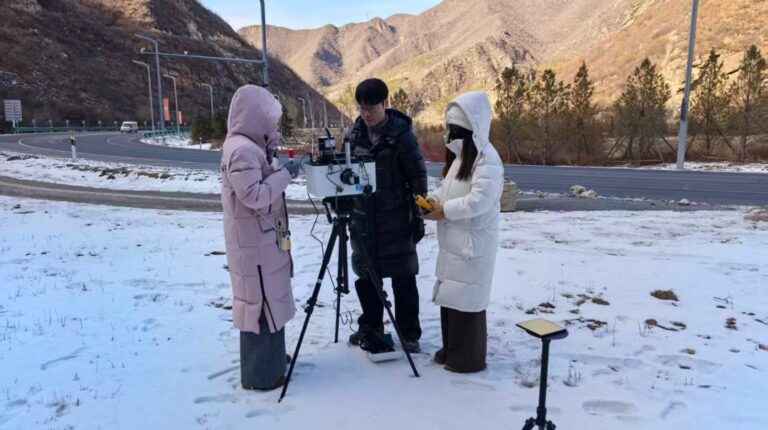
The experimental personnel observed the emissivity of the snow surface using a 102F infrared radiometer. Credit: China Meteorological Administration
Share
LinkedIn Facebook Twitter Email

China has launched a coordinated observation experiment to improve understanding of mountain snowfall processes and enhance winter forecasting capabilities. The North China Mountain Snowfall Cloud Microphysics–Surface Properties experiment began on December 11, 2025, in Chongli, Hebei Province.

The two-month experiment will collect firsthand datasets, including comprehensive snowflake microphysical data and snow-surface high-spectral emissivity data. Its findings are expected to support improvements in numerical weather prediction (NWP) models and strengthen snow disaster early warning capabilities across North China and nationwide.

Chongli was selected as the observation site due to its complex topography and distinctive climate. Han Wei, deputy chief engineer of the China Meteorological Administration (CMA) Earth System Modeling and Prediction Center (CEMC), said, “Chongli, as a typical mountainous snowfall region in North China with complex terrain and a unique climate, features well-structured snowfall cloud systems and diverse snowflake forms, making it a natural laboratory for studying microphysics and dynamic processes of mountain snowfall.”

The experiment employs a multiscale, multiplatform, highly coordinated observation approach to investigate the microphysical, dynamic and radiative characteristics of snowfall cloud systems. It aims to establish a complete physical chain linking the microscopic morphology and size spectrum of non-spherical snowflakes with their macroscopic radiative properties and microwave and infrared scattering characteristics.

A closed observation chain has been established covering what the CMA refers to as ‘microscopic properties–vertical structure–space-ground signals.’ This enables the collection of core observational data on snowflake microphysics and scattering properties.

Airborne observations are being conducted using weather modification aircraft equipped with cloud particle imaging probes. Guided by cloud radar, the aircraft will penetrate cloud and snowfall regions to directly measure the spatial distribution, size spectra, phase states and shapes of snowflakes and ice crystals, extending and validating ground-based observations.

Unmanned aerial vehicles (UAVs) equipped with multi-element meteorological sensors are also being deployed to conduct atmospheric vertical soundings, measuring parameters including temperature, humidity, pressure and wind.

From space, the Fengyun-4 series meteorological satellites will carry out enhanced regional high-spectral infrared observations during the experiment’s core phase. These coordinated space-ground measurements will support the validation and refinement of surface radiation models.

The project is being undertaken by multiple institutions, including CMA field experiment bases and laboratories, the National Key Laboratory of Severe Weather, CEMC, the Institute of Atmospheric Physics of the Chinese Academy of Sciences, the Chinese Academy of Meteorological Sciences, the National Satellite Meteorological Center, several universities, and the Zhangjiakou Municipal Meteorological Department.

In related news, China launches Fengyun-3H meteorological satellite to boost global climate monitoring and weather forecasting

Previous ArticleChina Meteorological Administration launches Tianhe platform to enhance smart meteorological services nationwide
Next Article New report highlights role of early warning systems in strengthening energy resilience

Read Similar Stories

Space Weather

Northumbria University secures £4m to study Earth’s radiation belts

April 16, 20262 Mins Read
Extreme Weather

AI model improves real-time prediction of wildfire spread

April 16, 20263 Mins Read
Climate Measurement

Study identifies atmospheric trigger behind flash droughts in Puerto Rico

April 15, 20263 Mins Read
Latest News

Northumbria University secures £4m to study Earth’s radiation belts

April 16, 2026

AI model improves real-time prediction of wildfire spread

April 16, 2026

Study identifies atmospheric trigger behind flash droughts in Puerto Rico

April 15, 2026

Receive breaking stories and features in your inbox each week, for free


Enter your email address:


Supplier Spotlights
  • Adolf Thies GmbH & Co. KG
Getting in Touch
  • Contact Us / Advertise
  • Meet the Editors
  • Media Pack
  • Free Weekly E-Newsletter
Our Social Channels
  • Facebook
  • LinkedIn
© 2026 UKi Media & Events a division of UKIP Media & Events Ltd
  • Cookie Policy
  • Privacy Policy
  • Terms and Conditions
  • Notice and Takedown Policy

Type above and press Enter to search. Press Esc to cancel.