


Close Menu
Meteorological Technology International
  • News
    • A-E
      • Agriculture
      • Automated Weather Stations
      • Aviation
      • Climate Measurement
      • Data
      • Developing Countries
      • Digital Applications
      • Early Warning Systems
      • Extreme Weather
    • G-P
      • Hydrology
      • Lidar
      • Lightning Detection
      • New Appointments
      • Nowcasting
      • Numerical Weather Prediction
      • Polar Weather
    • R-S
      • Radar
      • Rainfall
      • Remote Sensing
      • Renewable Energy
      • Satellites
      • Solar
      • Space Weather
      • Supercomputers
    • T-Z
      • Training
      • Transport
      • Weather Instruments
      • Wind
      • World Meteorological Organization
      • Meteorological Technology World Expo
  • Features
  • Online Magazines
    • January 2026
    • April 2025
    • January 2025
    • September 2024
    • April 2024
    • Archive Issues
    • Subscribe Free!
  • Opinion
  • Videos
  • Supplier Spotlight
  • Expo
LinkedIn X (Twitter) Facebook
  • Sign-up for Free Weekly E-Newsletter
  • Meet the Editors
  • Contact Us
  • Media Pack
LinkedIn Facebook
Subscribe
Meteorological Technology International
  • News
      • Agriculture
      • Automated Weather Stations
      • Aviation
      • Climate Measurement
      • Data
      • Developing Countries
      • Digital Applications
      • Early Warning Systems
      • Extreme Weather
      • Hydrology
      • Lidar
      • Lightning Detection
      • New Appointments
      • Nowcasting
      • Numerical Weather Prediction
      • Polar Weather
      • Radar
      • Rainfall
      • Remote Sensing
      • Renewable Energy
      • Satellites
      • Solar
      • Space Weather
      • Supercomputers
      • Training
      • Transport
      • Weather Instruments
      • Wind
      • World Meteorological Organization
      • Meteorological Technology World Expo
  • Features
  • Online Magazines
    1. January 2026
    2. September 2025
    3. April 2025
    4. January 2025
    5. September 2024
    6. April 2024
    7. January 2024
    8. September 2023
    9. April 2023
    10. Archive Issues
    11. Subscribe Free!
    Featured
    November 27, 2025

    In this Issue – January 2026

    By Hazel KingNovember 27, 2025
    Recent

    In this Issue – January 2026

    November 27, 2025

    In this Issue – September 2025

    August 11, 2025

    In this Issue – April 2025

    April 15, 2025
  • Opinion
  • Videos
  • Supplier Spotlight
  • Expo
Facebook LinkedIn
Subscribe
Meteorological Technology International
Climate Measurement

Carbon dioxide emissions need to slow by 20% to reach 1.5°C target, UK Met Office finds

Elizabeth BakerBy Elizabeth BakerJanuary 18, 20223 Mins Read
Share LinkedIn Facebook Twitter Email
To limit warming to 1.5°C, the carbon dioxide rise must slow rapidly and stop before 2050
Share
LinkedIn Facebook Twitter Email

According to the UK Met Office’s global carbon dioxide forecast for 2022, the rate that carbon dioxide is being added to the atmosphere needs to slow by around 20% over the next five-year period if global warming is to be limited to 1.5°C.

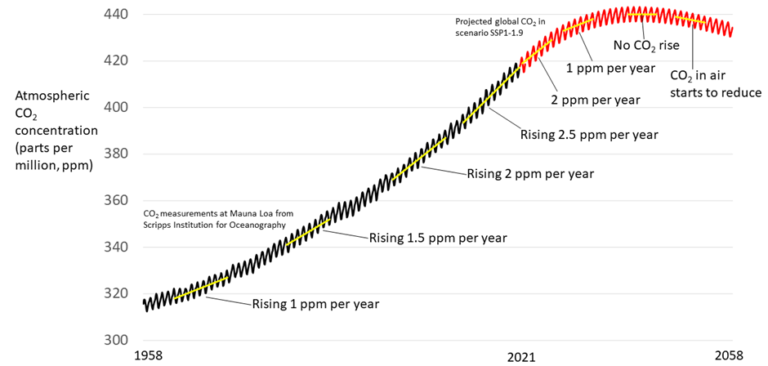
In 1958 – when the first measurements were taken at Hawaii’s Mauna Loa observatory – the rate of annual rise of carbon dioxide in the atmosphere was less than one part per million (ppm). The atmospheric concentration of CO2 was then about 316ppm. The rate of rise has accelerated over 60 years and the rise over the last 10 years has been nearly 2.5ppm per year, with the atmospheric concentration reaching 416ppm on average last year.

The Met Office forecast suggests that relative to 2021, the rise in the atmospheric concentration of CO2 in 2022 will be 2.14 ±0.52ppm. In the scenario used by the Intergovernmental Panel on Climate Change (IPCC) to study global warming limited to 1.5°C long term, the projected rise slows to an average of 2ppm per year over the next five years, almost 20% lower than the recent average annual rise. In that scenario, the rise then continues to slow rapidly and then comes to a halt in the early 2040s. Carbon-dioxide levels then decline over the rest of the century in that scenario. The human emissions driving this fall rapidly, reaching net zero mid-century and becoming negative after that.

Although the long-term rise in CO2 concentrations comes from human-induced activities, nature also influences the rate of rise because of variations in the strength of so-called natural carbon sinks – features like vegetation and oceans. These variations are driven by climate variability and show a strong correlation with the El Niño – La Niña cycles in the tropical Pacific. CO2 measurements at Mauna Loa are taken by the Scripps Institution of Oceanography at UC San Diego, USA, and also independently by the USA’s National Oceanic and Atmospheric Administration. The future scenario limiting warming to 1.5°C long term is the SSP1.1-9 scenario.

Prof. Richard Betts, who leads the Met Office team behind the CO2 forecast, said, “The last two years have seen successive La Niña events where we see a natural and temporary cooling of the tropical Pacific. During a La Niña event, we see relative cooler global temperature and a strengthening of carbon sinks, which can draw down more CO2 . However, in an El Niño year, such as 2016, we see hotter and drier conditions leading to reduced carbon uptake. Nevertheless, the long-term change is driven by human emissions.”

Betts added, “Our 2022 forecast suggests that nature will temporarily be doing our ‘heavy lifting’ this year as ecosystems – such as tropical forests – are expected to draw down a higher proportion of carbon dioxide from the atmosphere than usual. However, if the world is to meet ambitious targets within the Paris Agreement, the long-term buildup of CO2 in the atmosphere needs to slow rapidly and come to a halt before mid-century. This would need an immediate slowing in the rate that human-induced carbon-dioxide emissions are added to the atmosphere, leading rapidly to a complete stop. A temporary boost from nature is obviously welcome but we won’t get this free dividend in most years.”

Previous ArticleNOAA and BOEM collaboration to help advance US offshore wind capabilities
Next Article X-band weather radars to provide advanced flood warnings in northern Italy

Read Similar Stories

Climate Measurement

Study identifies atmospheric trigger behind flash droughts in Puerto Rico

April 15, 20263 Mins Read
Satellites

AI tool uses weather satellite data to map ocean currents in near real time

April 14, 20263 Mins Read
Climate Measurement

New tool speeds up climate model evaluation

April 13, 20262 Mins Read
Latest News

Northumbria University secures £4m to study Earth’s radiation belts

April 16, 2026

AI model improves real-time prediction of wildfire spread

April 16, 2026

Study identifies atmospheric trigger behind flash droughts in Puerto Rico

April 15, 2026

Receive breaking stories and features in your inbox each week, for free


Enter your email address:


Supplier Spotlights
  • ZOGLAB Microsystem Co., Ltd
Getting in Touch
  • Contact Us / Advertise
  • Meet the Editors
  • Media Pack
  • Free Weekly E-Newsletter
Our Social Channels
  • Facebook
  • LinkedIn
© 2026 UKi Media & Events a division of UKIP Media & Events Ltd
  • Cookie Policy
  • Privacy Policy
  • Terms and Conditions
  • Notice and Takedown Policy

Type above and press Enter to search. Press Esc to cancel.