


Close Menu
Meteorological Technology International
  • News
    • A-E
      • Agriculture
      • Automated Weather Stations
      • Aviation
      • Climate Measurement
      • Data
      • Developing Countries
      • Digital Applications
      • Early Warning Systems
      • Extreme Weather
    • G-P
      • Hydrology
      • Lidar
      • Lightning Detection
      • New Appointments
      • Nowcasting
      • Numerical Weather Prediction
      • Polar Weather
    • R-S
      • Radar
      • Rainfall
      • Remote Sensing
      • Renewable Energy
      • Satellites
      • Solar
      • Space Weather
      • Supercomputers
    • T-Z
      • Training
      • Transport
      • Weather Instruments
      • Wind
      • World Meteorological Organization
      • Meteorological Technology World Expo
  • Features
  • Online Magazines
    • January 2026
    • April 2025
    • January 2025
    • September 2024
    • April 2024
    • Archive Issues
    • Subscribe Free!
  • Opinion
  • Videos
  • Supplier Spotlight
  • Expo
LinkedIn X (Twitter) Facebook
  • Sign-up for Free Weekly E-Newsletter
  • Meet the Editors
  • Contact Us
  • Media Pack
LinkedIn Facebook
Subscribe
Meteorological Technology International
  • News
      • Agriculture
      • Automated Weather Stations
      • Aviation
      • Climate Measurement
      • Data
      • Developing Countries
      • Digital Applications
      • Early Warning Systems
      • Extreme Weather
      • Hydrology
      • Lidar
      • Lightning Detection
      • New Appointments
      • Nowcasting
      • Numerical Weather Prediction
      • Polar Weather
      • Radar
      • Rainfall
      • Remote Sensing
      • Renewable Energy
      • Satellites
      • Solar
      • Space Weather
      • Supercomputers
      • Training
      • Transport
      • Weather Instruments
      • Wind
      • World Meteorological Organization
      • Meteorological Technology World Expo
  • Features
  • Online Magazines
    1. January 2026
    2. September 2025
    3. April 2025
    4. January 2025
    5. September 2024
    6. April 2024
    7. January 2024
    8. September 2023
    9. April 2023
    10. Archive Issues
    11. Subscribe Free!
    Featured
    November 27, 2025

    In this Issue – January 2026

    By Hazel KingNovember 27, 2025
    Recent

    In this Issue – January 2026

    November 27, 2025

    In this Issue – September 2025

    August 11, 2025

    In this Issue – April 2025

    April 15, 2025
  • Opinion
  • Videos
  • Supplier Spotlight
  • Expo
Facebook LinkedIn
Subscribe
Meteorological Technology International
Climate Measurement

2021 Antarctic ozone hole one of the longest-lasting on record, says CAMS

Elizabeth BakerBy Elizabeth BakerDecember 21, 20213 Mins Read
Share LinkedIn Facebook Twitter Email
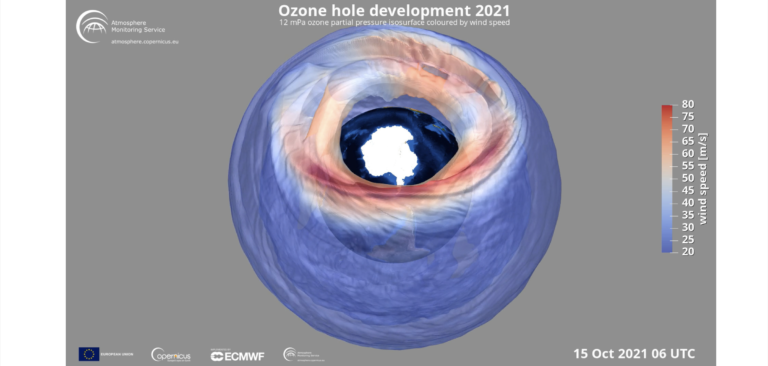
Credit: Copernicus Atmosphere Monitoring Service, ECMWF
Still from an animation of the ozone hole on October 15, 2021
Share
LinkedIn Facebook Twitter Email

Scientists from the Copernicus Atmosphere Monitoring Service (CAMS) have confirmed that the 2021 Antarctic ozone hole season has almost reached its end. The closure is expected to occur only a few days earlier than in 2020, which was the longest-lasting since 1979.

Similar to last year’s season, the service found that the ozone hole in 2021 will be one of the largest and longest-lasting on record, closing later than 95% of all tracked ozone holes since 1979. Computer models of the atmosphere are combined with measurements from satellites and in-situ stations to closely monitor the evolution of the phenomenon. As the stratospheric ozone layer acts as a shield, protecting Earth from potentially harmful ultraviolet radiation, CAMS says it is vitally important to track these changes.

The ozone hole is formed through the accumulation of chlorine- and bromine-containing substances within the polar vortex, where they stay chemically inactive in the darkness. Temperatures in the vortex can fall to below -78°C and ice crystals in polar stratospheric clouds can form; these play an important part in the chemical reactions. As the sun rises over the pole, its energy releases chemically active chlorine and bromine atoms in the vortex, which rapidly destroy ozone molecules, causing the hole to form.

This CAMS program was implemented by the European Centre for Medium-Range Weather Forecasts (ECMWF) on behalf of the European Commission, with funding from the European Union. It aims to preserve the ozone layer by continually monitoring and delivering data about its current state.

Vincent-Henri Peuch, director of CAMS at ECMWF, commented, “Both the 2020 and 2021 Antarctic ozone holes have been rather large and exceptionally long-lived. These two longer-than-usual episodes in a row are not a sign that the Montreal Protocol is not working though, as without it, they would have been even larger. It is because of interannual variability due to meteorological and dynamical conditions that can have an important impact on the magnitude of the ozone hole and are superimposed on the long-term recovery. CAMS also keeps an eye on the amount of UV radiation reaching the Earth’s surface, and we’ve seen in recent weeks very high UV indexes – in excess of eight – over parts of Antarctica situated below the ozone hole.”

The Montreal Protocol, signed in 1978, is a climate action agreement to protect the ozone layer. It bans harmful chemicals that are linked to ozone destruction and depletion, such as chlorofluorocarbons (CFCs) and hydrofluorocarbons (HFCs). These chemicals remain in the atmosphere for a long time and reach the stratosphere, where they have been found to contribute to ozone depletion. The Montreal Protocol has ensured that the concentrations of these chemicals are slowly decreasing. However, because of the chemicals’ long lifetimes, this research confirms that it will still take about four decades for the ozone layer to fully recover.

Peuch added, “CAMS monitors and observes the ozone layer by providing reliable and free-to-access data based on different types of satellite observations and numerical modeling, which makes the monitoring of the inception, development and closure of the yearly ozone holes possible in a detailed way. The compiled data, along with our forecasts, allows us to follow the ozone season and compare its development against the ones of the last 40 years.”
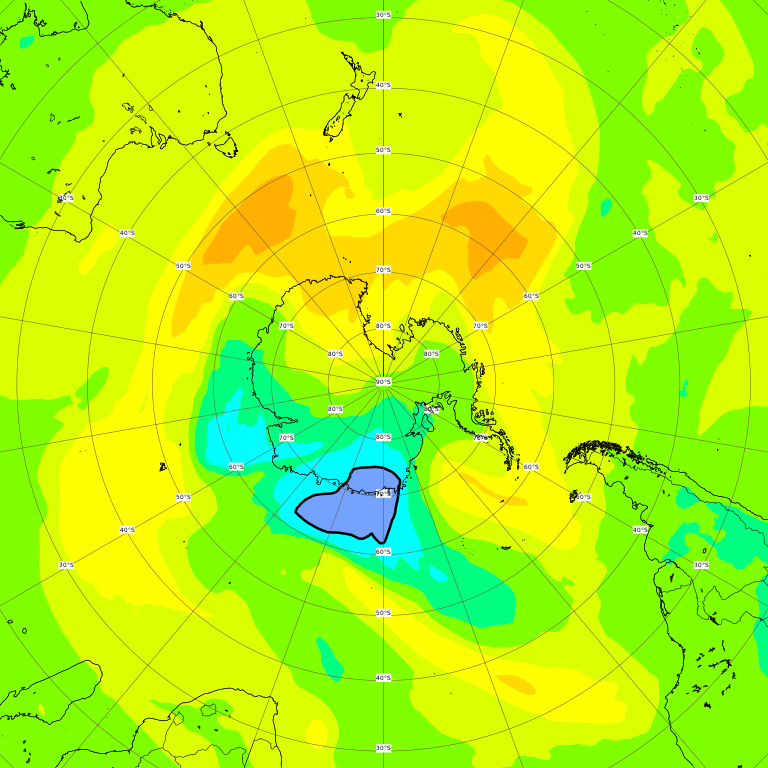
Total column ozone field forecast for December 20, 2021 from CAMS, showing only a small area with values below 220 DU over the Antarctic
Both images ©Copernicus Atmosphere Monitoring Service, ECMWF
Previous ArticleOTT HydroMet installs weather station to predict ice formation on power lines in Scotland
Next Article Researcher discovers meteorological phenomenon coined ‘atmospheric lakes’

Read Similar Stories

Climate Measurement

Study identifies atmospheric trigger behind flash droughts in Puerto Rico

April 15, 20263 Mins Read
Satellites

AI tool uses weather satellite data to map ocean currents in near real time

April 14, 20263 Mins Read
Climate Measurement

New tool speeds up climate model evaluation

April 13, 20262 Mins Read
Latest News

Northumbria University secures £4m to study Earth’s radiation belts

April 16, 2026

AI model improves real-time prediction of wildfire spread

April 16, 2026

Study identifies atmospheric trigger behind flash droughts in Puerto Rico

April 15, 2026

Receive breaking stories and features in your inbox each week, for free


Enter your email address:


Supplier Spotlights
  • Meteomatics AG
Getting in Touch
  • Contact Us / Advertise
  • Meet the Editors
  • Media Pack
  • Free Weekly E-Newsletter
Our Social Channels
  • Facebook
  • LinkedIn
© 2026 UKi Media & Events a division of UKIP Media & Events Ltd
  • Cookie Policy
  • Privacy Policy
  • Terms and Conditions
  • Notice and Takedown Policy

Type above and press Enter to search. Press Esc to cancel.