The World Meteorological Organization (WMO) and the European Union’s Copernicus Climate Change Service have released the European State of the Climate 2022 report, the second in an annual series.
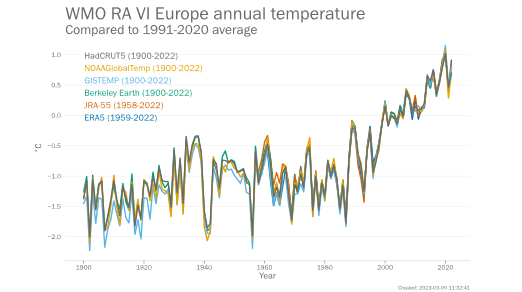
It shows how Europe has been warming twice as much as the global average since the 1980s, with far-reaching impacts on the region’s socioeconomic fabric and ecosystems. In 2022, Europe was approximately 2.3°C above the pre-industrial (1850-1900) average used as a baseline for the Paris Agreement on climate change.
However, in a sign of hope for the future, last year renewable energy generated more electricity than polluting fossil fuel gas for the first time. Wind and solar power generated 22.3% of European Union (EU) electricity in 2022, overtaking fossil fuel gas (20%).
Prof. Petteri Taalas, WMO secretary-general, said, “For the first time, more electricity was generated by wind and solar than by fossil gas in the EU. Increasing use of renewables and low-carbon energy sources is crucial to reduce dependence on fossil fuels. Climate services play a key role in ensuring the resilience of energy systems to climate-related shocks, in planning operations, and in informing measures to increase energy efficiency.”
The report has a special focus on energy and highlights how more extreme weather, including intense heat, heavy precipitation and droughts, have growing implications for the supply, demand and infrastructure of Europe’s energy system.
Dr Carlo Buontempo, director, Copernicus Climate Change Service, said, “The record-breaking heat stress that Europeans experienced in 2022 was one of the main drivers of weather-related excess deaths in Europe. Unfortunately, this cannot be considered a one-off occurrence or an oddity of the climate. Our current understanding of the climate system and its evolution informs us that these kinds of events are part of a pattern that will make heat stress extremes more frequent and more intense across the region.”
Based on information in the Emergency Events Database (EM-DAT), meteorological, hydrological and climate-related hazards in Europe in 2022 resulted in 16,365 reported fatalities and directly affected 156,000 people.
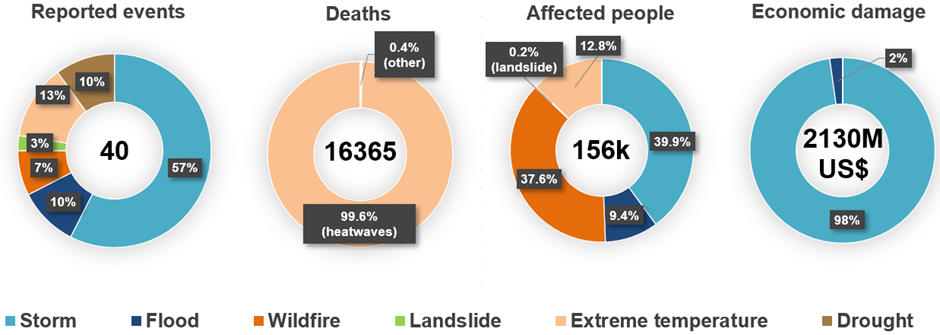
Around 67% of the events were flood- and storm-related, accounting for most of the total economic damages of about US$2bn. Much more severe, in terms of mortality, were the heatwaves, which reportedly led to more than 16,000 excess deaths.
“In 2022, many countries in western and south-western Europe had their warmest year on record. Summer was the hottest ever recorded: the high temperatures exacerbated the severe and widespread drought conditions, fueled violent wildfires that resulted in the second largest burned area on record, and led to thousands of heat-associated excess deaths,” said Taalas.
Rising temperatures
Europe saw its warmest summer on record. Several countries, including Belgium, France, Germany, Ireland, Italy, Luxembourg, Portugal, Spain, Switzerland and the UK had their warmest year on record.
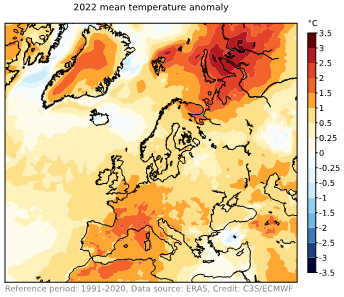 The 2022 annual average temperature for Europe was between the second and fourth highest on record, with an anomaly of about 0.79 °C above the 1991–2020 average. This baseline is used as a standard reference to compare variations in temperature, precipitation, etc, to the 30-year average and thus provide information to climate-sensitive sectors.
Precipitation was below average across much of the region in 2022. It was the fourth dry year in a row on the Iberian Peninsula, and the third consecutive dry year in the mountain regions of the Alps and Pyrenees.
France had its driest January to September, and the UK and Uccle (Belgium) had their driest January to August since 1976, with far-reaching consequences for agriculture and energy production. Spain’s water reserve decreased to 41.9% of its total capacity by 26 July, with even lower capacity in some basins.
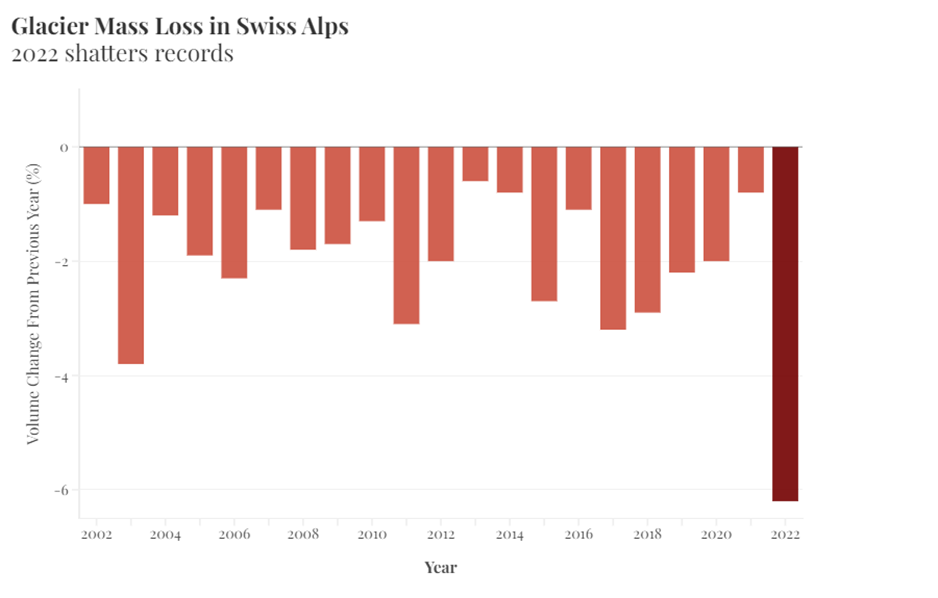
Glaciers in Europe lost a volume of about 880km3 of ice from 1997 to 2022. The Alps were worst affected, with an average reduction in ice thickness of 34m. In 2022, glaciers in the European Alps experienced a new record mass loss in one single year, caused by very low winter snow amounts, a very warm summer and Saharan dust deposition.
The Greenland Ice Sheet lost 5,362 ± 527Gt of ice between 1972 and 2021, contributing about 14.9mm to global mean sea level rise. It continued to lose mass during 2022, according to scientific assessments.
Average sea surface temperatures across the North Atlantic area were the warmest on record and large portions of the region’s seas were affected by strong or even severe and extreme marine heatwaves.
The rates of surface ocean warming, particularly in the eastern Mediterranean Sea, the Baltic and Black Seas, and the southern Arctic, were more than three times the global average.
Marine heatwaves lead to migration of species and mass extinctions, arrival of invasive species and disruption of ecosystems and biodiversity.
To view the State of the Climate in Europe 2022 report in full, click here.