


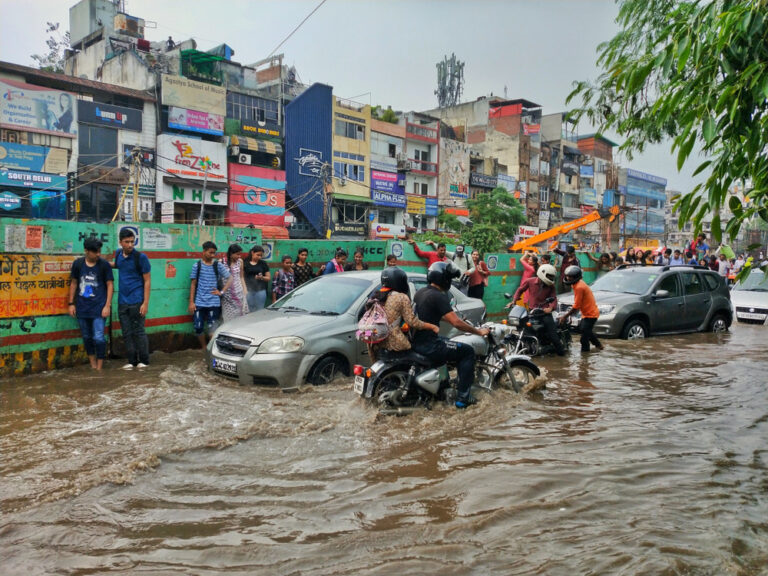
The South Asian summer monsoon directly affects the lives of around one billion people, providing 80% of annual rainfall in the region. The 2019 monsoon caused significant flooding in some parts of India. Gaining a greater understanding of this force of nature is the focus of a major initiative between India and the UK.
WCSSP India – a Weather and Climate Science for Service Partnership between the UK Met Office and the Indian Ministry of Earth Sciences (MoES) aspires to reduce the risk of monsoon-related disasters.
The development of weather and climate services is becoming increasingly important in addressing some of the biggest global challenges of our time, including disaster risk reduction, global security, economic development and social welfare. The cross-border nature of impacts and the importance of international cooperation in response mean that working through genuine partnerships is vital in addressing these challenges.
Since 1970 Asia has been hit by more than 5,000 natural disasters. In India, and indeed across most of South Asia, many of the natural hazards are related to the weather and climate of the South Asian monsoon.
Forecasting the precise timing and location of the rains is vital to the region’s economy, which is dominated by farming, and for managing its water resources. For example, in July 2002 less than half of the usual rainfall fell which affected agricultural yields. More recently, in August 2018, the southern India state of Kerala experienced a severe spell of rainfall causing the worst flooding event in 100 years. With the increase in the frequency of extreme weather events accurate predictions are essential to help communities prepare for floods and droughts and for farmers to plan their crop planting.
Dr M Rajeevan, secretary, Ministry of Earth Sciences says, “Accurate prediction of Cyclone Fani has established that we have attained great skill in prediction of intensity and track of cyclones, however much needs to be done for extreme weather events in particular heavy rainfall and floods.
“The joint collaborative effort between MoES and the Met Office under the WCSSP program, will help to address this through development of appropriate tools for multi-hazard warning and impact based forecasting.”
The WCSSP India project, launched at the end of July 2019, is already delivering science research to support service development, with a paper published in July with contributing scientists from the Met Office, the Indian National Centre for Medium‐Range Weather Forecasts and Kings College London. This latest paper has established a set of specific daily weather patterns and examined how they relate to rainfall variability. These weather patterns can then be applied to future research on the occurrence of high impact weather and meteorologically induced hazards such as landslides. The findings can also be used for medium to long-range weather pattern forecasting over India.
Elsewhere the project has also produced the first lightning forecasts for India using a model that’s able to capture individual convective storms. The work in collaboration with Indian research partners reveals that lightning storms can occur over large regions of India and could be stronger than previously thought, outlining the risks posed by this form of high-impact weather to the Indian population. This innovation demonstrates the first step toward Indian research partners developing an operational lightning forecasting product, which could help reduce the number of lightning-related hazards.
Sean Milton is the Met Office science lead for WCSSP India. He says, “The project is advancing scientific understanding and modelling capabilities to improve predictions and forecasting tools of natural hazards related to the Indian summer monsoon, from hours to a season ahead.
“The project will also gather new, detailed observations of monsoon processes through satellites and research field campaigns. All of these activities will further our understanding of the monsoon and improve the representation of its key processes in models, thereby improving predictions of monsoon-related hazards and extreme weather over the region. This information will be translated into new forecast products that will facilitate improved early warning and communication of high-impact events to help protect lives and livelihoods over India.”