


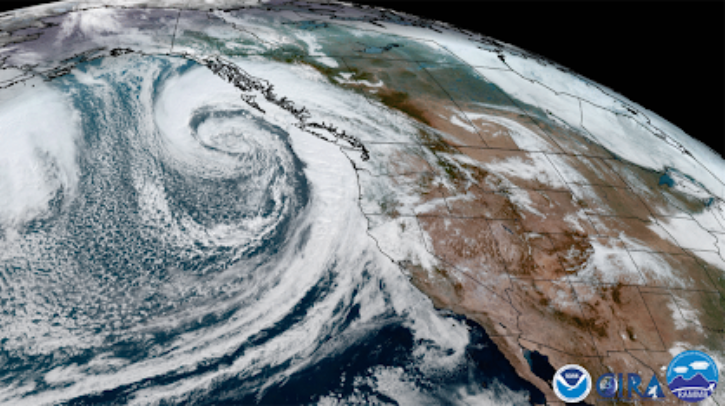
As the western USA heads into its traditional dry season, water managers are assessing how winter rains have helped replenish the region’s reservoirs. The vast majority of precipitation that falls during the wet season results from atmospheric rivers (ARs) that rain down life-sustaining water but can also cause costly destruction. These fast-moving “rivers” of water vapor in the sky supply up to half of the region’s annual precipitation, with stronger ARs responsible for the majority of flood damages along the West Coast.
To aid in predicting and monitoring these extreme weather events, NOAA Physical Sciences Laboratory (PSL) operates nine atmospheric river observatories at sites distributed along the coast from Washington to Southern California. These unmanned weather stations send round-the-clock observations back to the laboratory, which analyzes and displays the data publicly on its Atmospheric River Portal. The National Weather Service uses this data portal to produce forecasts and weather warnings. State and local agencies also use the portal for creating water management strategies and emergency response planning.
A ‘picket fence’ along the coast
Atmospheric rivers are long currents of water vapor that form in the tropics over the open ocean and are carried to higher latitudes by strong winds. NOAA satellites are best suited to monitor these storms, which are categorized on a scale similar to hurricanes or tornadoes, before they make landfall, but once an AR arrives at our doorstep, satellites fail to adequately capture its complex interaction with the mountainous terrain of the West Coast.
“While satellites can observe the winds at the top of an atmospheric river’s clouds, they cannot see inside where the wind and moisture determine how hard it will rain or where the AR will make landfall,” said Rob Cifelli, recently retired radar meteorologist, who also served as the lead precipitation and AR scientist at the NOAA Physical Sciences Laboratory.
This observational gap led PSL researchers to develop the plan for a ‘picket fence’ of ground-based observatories along the coast. PSL installed seven coastal and two inland stations between 2013 and 2017 with funding from the California Department of Water Resources and the US Department of Energy. PSL has continuously maintained and improved the network of atmospheric river observatory (ARO) stations in the years since.
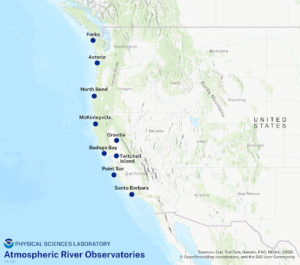
“The AROs provide NOAA researchers and the scientific community with data from within ARs that instruments like the satellites and traditional weather radars cannot,” Cifelli added. “This allows us to study the internal structure, improve our understanding of how ARs behave, and evaluate existing model forecasts to improve our predictions of the intensity, duration and location of these storms. Better forecasts lead to better flood preparedness and water management in the affected areas.”
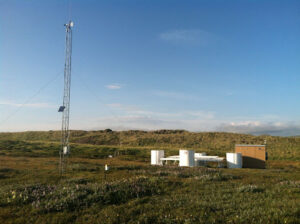
In total, the ARO network comprises over 100 sensors and instruments that monitor key environmental variables including water vapor concentration, wind speed and direction, freezing elevation and soil moisture. These instruments include compact wind profilers that use technology invented and assembled by PSL engineers.
The nine AROs complement other methods used by NOAA and partners to monitor ARs and to paint a clearer picture of real-time conditions across the wide region. Other monitoring methods include satellites, aircraft reconnaissance missions and additional land-based observations. This information can be accessed through an Atmospheric River Portal hosted by PSL, which offers visualizations of current conditions as well as computer model forecasts of future AR conditions.
Serving up critical data, rain or shine
PSL’s ongoing support of the ARO network remains a central part of the lab’s mission to advance the prediction of water availability and extremes. While the West Coast gets a break from atmospheric rivers during the summer months, PSL engineers and field scientists will be busy doing maintenance on the observatories in preparation for the next rainy season.
As Jennifer Bednar, the lead of PSL’s Data, Instrumentation and Field Campaigns Division, explained, “The dry season gives our small team a critical window of time to keep our ARO network intact to ensure the National Weather Service and others continue to benefit from the over 21 million observations the network produces annually.” Furthermore, the AROs serve a complementary role in the summer months to monitor soil moisture and drought conditions in support of the National Integrated Drought Information System.
In addition to the nine dedicated atmospheric river observatories, there are 48 other sites throughout California, Oregon and Washington that contribute to atmospheric river observations and are maintained by PSL engineers. This observational data is made publicly available to be used by others in addition to NOAA to serve applications including emergency preparedness, wastewater system management, reservoir operations, and more. To explore the data yourself, visit the PSL Observation Network.
In related news, NOAA’s GOES-19 satellite, the final satellite in its GOES-R Series, recently began official operations as GOES East. Click here to read the full story