

Close Menu
Meteorological Technology International
  • News
    • A-E
      • Agriculture
      • Automated Weather Stations
      • Aviation
      • Climate Measurement
      • Data
      • Developing Countries
      • Digital Applications
      • Early Warning Systems
      • Extreme Weather
    • G-P
      • Hydrology
      • Lidar
      • Lightning Detection
      • New Appointments
      • Nowcasting
      • Numerical Weather Prediction
      • Polar Weather
    • R-S
      • Radar
      • Rainfall
      • Remote Sensing
      • Renewable Energy
      • Satellites
      • Solar
      • Space Weather
      • Supercomputers
    • T-Z
      • Training
      • Transport
      • Weather Instruments
      • Wind
      • World Meteorological Organization
      • Meteorological Technology World Expo
  • Features
  • Online Magazines
    • January 2026
    • April 2025
    • January 2025
    • September 2024
    • April 2024
    • Archive Issues
    • Subscribe Free!
  • Opinion
  • Videos
  • Supplier Spotlight
  • Expo
LinkedIn X (Twitter) Facebook
  • Sign-up for Free Weekly E-Newsletter
  • Meet the Editors
  • Contact Us
  • Media Pack
LinkedIn Facebook
Subscribe
Meteorological Technology International
  • News
      • Agriculture
      • Automated Weather Stations
      • Aviation
      • Climate Measurement
      • Data
      • Developing Countries
      • Digital Applications
      • Early Warning Systems
      • Extreme Weather
      • Hydrology
      • Lidar
      • Lightning Detection
      • New Appointments
      • Nowcasting
      • Numerical Weather Prediction
      • Polar Weather
      • Radar
      • Rainfall
      • Remote Sensing
      • Renewable Energy
      • Satellites
      • Solar
      • Space Weather
      • Supercomputers
      • Training
      • Transport
      • Weather Instruments
      • Wind
      • World Meteorological Organization
      • Meteorological Technology World Expo
  • Features
  • Online Magazines
    1. January 2026
    2. September 2025
    3. April 2025
    4. January 2025
    5. September 2024
    6. April 2024
    7. January 2024
    8. September 2023
    9. April 2023
    10. Archive Issues
    11. Subscribe Free!
    Featured
    November 27, 2025

    In this Issue – January 2026

    By Hazel KingNovember 27, 2025
    Recent

    In this Issue – January 2026

    November 27, 2025

    In this Issue – September 2025

    August 11, 2025

    In this Issue – April 2025

    April 15, 2025
  • Opinion
  • Videos
  • Supplier Spotlight
  • Expo
Facebook LinkedIn
Subscribe
Meteorological Technology International
Features

Improving hydrological predictions of land system models

Dr Thibault Hallouin, Computational Scientist – Hydro-JULES Project, University of ReadingBy Dr Thibault Hallouin, Computational Scientist – Hydro-JULES Project, University of ReadingDecember 9, 20203 Mins Read
Share LinkedIn Facebook Twitter Email
Share
LinkedIn Facebook Twitter Email

Given the existence of feedbacks between the Earth’s atmosphere and the Earth’s surface, hydrological knowledge (e.g. soil moisture and open water available for evaporation and plant transpiration) is as critical to atmospheric scientists as meteorological knowledge is to hydrologists. In the context of a changing climate, both communities need to work together so that we can model the impacts of changes in atmospheric conditions on hydrological conditions and vice versa. This is crucial to answering key societal questions regarding the future availability of water resources, and the intensity of extremes such as floods and droughts.

Historically, land system models were developed as a lower boundary condition to atmospheric models. To this day, this still has implications on how land system models represent hydrological processes. When a land system model is coupled to an atmospheric model, it typically inherits the spatial resolution of the atmospheric model. However, the spatial resolution of any model must be appropriately chosen with respect to the spatial scale of the dynamics being modeled, and the spatial scales of atmospheric and hydrological processes can differ. Land system models typically use a tiling scheme to consider any sub-grid heterogeneity beyond the atmospheric grid resolution: the resolution of the land system is split into a collection of tiles, each considering different functional types (e.g. vegetation, bare soil, urban fabric, ice sheet, etc.). From a hydrological point of view, this approach is insufficient because it does not consider lateral movement of water on or below the surface, and it does not necessarily resolve the hydrological dynamics at their adequate spatial scale.

In order to overcome these limitations, the NERC National Capability 5-year program Hydro-JULES is developing a framework for models of the terrestrial water cycle (see Figure 1). In collaboration with the UK Centre for Ecology & Hydrology, Bryan Lawrence, Grenville Lister and I actively contribute to the implementation of this framework, given the expertise of the Department of Meteorology in complex model development and model integration.
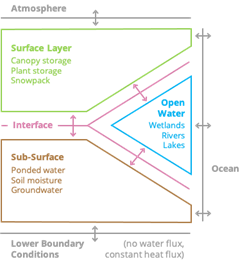
Figure 1: The Hydro-JULES framework subdividing the terrestrial water cycle into three inter-connected components.

This framework represents the hydrological processes in the terrestrial water cycle as three interconnected components: surface layer, subsurface and open water. Each component runs at its own resolution. This supports lateral movement of water and water-borne contaminants through the landscape and allows for the community of hydrological modelers to contribute alternative components that can be compared with existing ones, to improve hydrological predictions.

In collaboration with the UK Met Office, a key objective of Hydro-JULES is to refactor the Joint UK Land Environment Simulator (JULES) so it complies with this new framework. JULES is the land component currently used in the Met Office Unified Model, as in, for example, the UK Earth System Model configuration. JULES is also used on its own to model the land system alone. Therefore, advances in the representation of hydrological processes in JULES will not only benefit the hydrological community but will also benefit atmospheric modelers. Accounting for the lateral movement of water will also benefit ocean and Earth system modelers because water-borne contaminants such as nutrients and sediment are drained to the oceans.

This article was originally published by the University of Reading here.

Previous ArticleWMO Provisional Report on the State of the Global Climate in 2020
Next Article NOAA’s Arctic Report Card 2020

Read Similar Stories

Features

FEATURE: How the Arctic oscillation fueled widespread winter storms

April 9, 20265 Mins Read
Features

EXCLUSIVE INTERVIEW: Chris Hyde, energy lead at Meteomatics

March 19, 20264 Mins Read
Features

EXCLUSIVE INTERVIEW: Mausumi Dikpati, NSF NCAR senior scientist

March 5, 20265 Mins Read
Latest News

Northumbria University secures £4m to study Earth’s radiation belts

April 16, 2026

AI model improves real-time prediction of wildfire spread

April 16, 2026

Study identifies atmospheric trigger behind flash droughts in Puerto Rico

April 15, 2026

Receive breaking stories and features in your inbox each week, for free


Enter your email address:


Supplier Spotlights
  • Synoptic Data PBC
Getting in Touch
  • Contact Us / Advertise
  • Meet the Editors
  • Media Pack
  • Free Weekly E-Newsletter
Our Social Channels
  • Facebook
  • LinkedIn
© 2026 UKi Media & Events a division of UKIP Media & Events Ltd
  • Cookie Policy
  • Privacy Policy
  • Terms and Conditions
  • Notice and Takedown Policy

Type above and press Enter to search. Press Esc to cancel.