


Close Menu
Meteorological Technology International
  • News
    • A-E
      • Agriculture
      • Automated Weather Stations
      • Aviation
      • Climate Measurement
      • Data
      • Developing Countries
      • Digital Applications
      • Early Warning Systems
      • Extreme Weather
    • G-P
      • Hydrology
      • Lidar
      • Lightning Detection
      • New Appointments
      • Nowcasting
      • Numerical Weather Prediction
      • Polar Weather
    • R-S
      • Radar
      • Rainfall
      • Remote Sensing
      • Renewable Energy
      • Satellites
      • Solar
      • Space Weather
      • Supercomputers
    • T-Z
      • Training
      • Transport
      • Weather Instruments
      • Wind
      • World Meteorological Organization
      • Meteorological Technology World Expo
  • Features
  • Online Magazines
    • January 2026
    • April 2025
    • January 2025
    • September 2024
    • April 2024
    • Archive Issues
    • Subscribe Free!
  • Opinion
  • Videos
  • Supplier Spotlight
  • Expo
LinkedIn X (Twitter) Facebook
  • Sign-up for Free Weekly E-Newsletter
  • Meet the Editors
  • Contact Us
  • Media Pack
LinkedIn Facebook
Subscribe
Meteorological Technology International
  • News
      • Agriculture
      • Automated Weather Stations
      • Aviation
      • Climate Measurement
      • Data
      • Developing Countries
      • Digital Applications
      • Early Warning Systems
      • Extreme Weather
      • Hydrology
      • Lidar
      • Lightning Detection
      • New Appointments
      • Nowcasting
      • Numerical Weather Prediction
      • Polar Weather
      • Radar
      • Rainfall
      • Remote Sensing
      • Renewable Energy
      • Satellites
      • Solar
      • Space Weather
      • Supercomputers
      • Training
      • Transport
      • Weather Instruments
      • Wind
      • World Meteorological Organization
      • Meteorological Technology World Expo
  • Features
  • Online Magazines
    1. January 2026
    2. September 2025
    3. April 2025
    4. January 2025
    5. September 2024
    6. April 2024
    7. January 2024
    8. September 2023
    9. April 2023
    10. Archive Issues
    11. Subscribe Free!
    Featured
    November 27, 2025

    In this Issue – January 2026

    By Hazel KingNovember 27, 2025
    Recent

    In this Issue – January 2026

    November 27, 2025

    In this Issue – September 2025

    August 11, 2025

    In this Issue – April 2025

    April 15, 2025
  • Opinion
  • Videos
  • Supplier Spotlight
  • Expo
Facebook LinkedIn
Subscribe
Meteorological Technology International
World Meteorological Organization

WMO’s early warnings and extreme heat missions discussed at 80th UN General Assembly

Alex PackBy Alex PackSeptember 23, 20253 Mins Read
Share LinkedIn Facebook Twitter Email
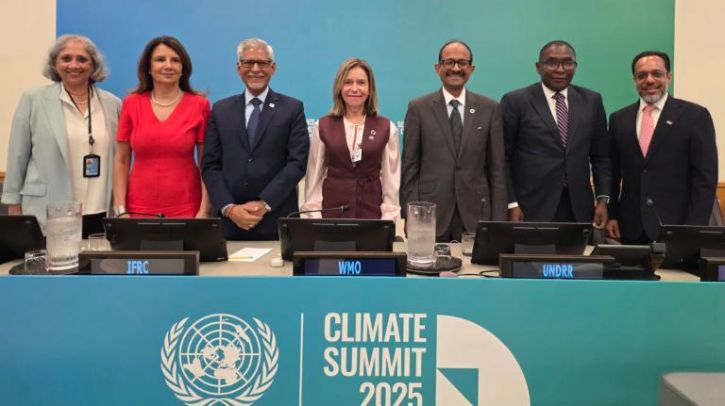
WMO’s early warnings and extreme heat missions discussed at 80th UN General Assembly.
Credit: WMO/UN
Share
LinkedIn Facebook Twitter Email

The contribution of the WMO to global well-being and security will be highlighted this week at the 80th UN General Assembly.

A high-level solutions dialog on accelerating early warning and extreme heat solutions highlighted the need for increased financing, inclusive partnerships, technological innovation and intentional action to protect vulnerable communities worldwide. The outcomes and recommendations will inform the UN Secretary-General’s Climate Summit on September 24.

Speaking at the event, WMO secretary-general Celeste Saulo said, “We are here today for one urgent and unifying purpose: solutions. Solutions that turn science into decisions, transform warnings into action, build long-term resilience, and that are based on data sharing and trust.

“We have good news and can report progress. Quite simply, early warnings are saving lives. Early Warnings for All is no longer just an initiative. It is a brand – a global movement.”

The United Nations secretary-general’s Early Warnings for All (EW4ALL) initiative aims to ensure that every person on Earth is protected by early warning systems by 2027. With two years remaining to meet this goal, Saulo stressed the importance of accelerating progress on all fronts.

This is said to require technology to bridge the digital divide, high-level political support, embracing an approach that involves all of society, and prioritizing the most vulnerable sectors of society and the most extreme hazards.

Reported progress

The WMO reported the following developments:

  • More than 60% of countries now report having multi-hazard early warning systems, with the least developed countries having doubled capacity since official reporting began;
  • Disaster-related mortality is at least six times lower in countries with good early warning systems;
  • Just 24 hours’ notice of a hazardous event can reduce damage by up to 30%;
  • From 2015-2022, 2.1 billion people were evacuated in advance thanks to early warning systems;
  • Heat-health action plans are helping countries prepare and respond, protecting millions of people all over the world.

Extreme heat

The WMO also stressed that more needs to be done to address one of the deadliest hazards: extreme heat.

The organization has found that temperatures above 40°C – even above 50°C – are becoming more common, with cascading effects on health, water and food resources, labor productivity, and energy and transportation systems.

The UN secretary-general’s Call to Action on Extreme Heat has heightened awareness and boosted investment, says the WMO. But more needs to be done across all sectors to accelerate delivery.

The solutions dialog laid out a three-pronged approach: emission reductions and mitigation; redesign of urban centers and facilities; and systemic governance responses, including integrated decision-making, heat action planning and investment informed by hazard science and early warning systems.

According to WHO and WMO estimates, scaling up heat health warning systems in just 57 countries could save nearly 100,000 lives every year.

Moving forward, Saulo called for commitment to three essential actions: scaling up financing for early warning systems; integrating early warning systems into all nationally determined contributions and national adaptation plans; and strengthening cross-sector collaboration to reach the last mile to ensure no one is left behind.

The aim of the dialog was to identify concrete, high-impact solutions ahead of COP30 in Belém, Brazil. The outcomes will be reported at a Special High-Level Event on Climate Action on September 24, 2025, as a platform for leaders to present their new nationally determined contributions (NDCs).

In related news, the China Meteorological Administration has shared its Global Climate Datasets internationally for the first time

Previous ArticleMet Éireann and University College Dublin to harness AI for weather prediction with new €5m facility
Next Article NOAA awards $24.3m contract to PlanetiQ for satellite weather data

Read Similar Stories

Extreme Weather

AI model improves real-time prediction of wildfire spread

April 16, 20263 Mins Read
Climate Measurement

Study identifies atmospheric trigger behind flash droughts in Puerto Rico

April 15, 20263 Mins Read
Satellites

AI tool uses weather satellite data to map ocean currents in near real time

April 14, 20263 Mins Read
Latest News

Northumbria University secures £4m to study Earth’s radiation belts

April 16, 2026

AI model improves real-time prediction of wildfire spread

April 16, 2026

Study identifies atmospheric trigger behind flash droughts in Puerto Rico

April 15, 2026

Receive breaking stories and features in your inbox each week, for free


Enter your email address:


Supplier Spotlights
  • ZX Lidars
Getting in Touch
  • Contact Us / Advertise
  • Meet the Editors
  • Media Pack
  • Free Weekly E-Newsletter
Our Social Channels
  • Facebook
  • LinkedIn
© 2026 UKi Media & Events a division of UKIP Media & Events Ltd
  • Cookie Policy
  • Privacy Policy
  • Terms and Conditions
  • Notice and Takedown Policy

Type above and press Enter to search. Press Esc to cancel.