


NOAA’s Space Weather Prediction Center (SWPC) has issued a revised prediction for solar activity during Solar Cycle 25 that concludes solar activity will increase more quickly and peak at a higher level than that predicted by an expert panel in December 2019. The updated prediction now calls for Solar Cycle 25 to peak between January and October of 2024, with a maximum sunspot number between 137 and 173.
The prediction marks the debut of SWPC’s experimental Updated Solar Cycle Prediction Product on the Space Weather Prediction Testbed website. The website offers SWPC partners and customers the opportunity to provide feedback on the product before it is fully integrated into SWPC operations. During this time, the product will be updated monthly to provide an accurate, up-to-date prediction for the progression of Solar Cycle 25, which began in 2019.
Mark Miesch, a CIRES scientist who serves as the solar cycle lead at SWPC, said, “The forecast for Cycle 25 had not been updated since its release in 2019 and is no longer reliable enough for SWPC’s customers, many of whom plan their operations years. We expect that our new experimental forecast will be much more accurate than the 2019 panel prediction and, unlike previous solar cycle predictions, it will be continuously updated every month as new sunspot observations become available. It’s a pretty significant change.”
No two solar cycles are the same, Miesch added. Solar magnetic variability – here measured by sunspot number – regulates the frequency and severity of space weather events and hazards, which can interfere with the electrical grid, degrade GPS signals, increase the orbital drag on satellites, and pose radiation hazards to airline crews and astronauts. Stronger solar cycles produce more solar storms with greater intensity and therefore pose a larger hazard for these critical technologies and services.
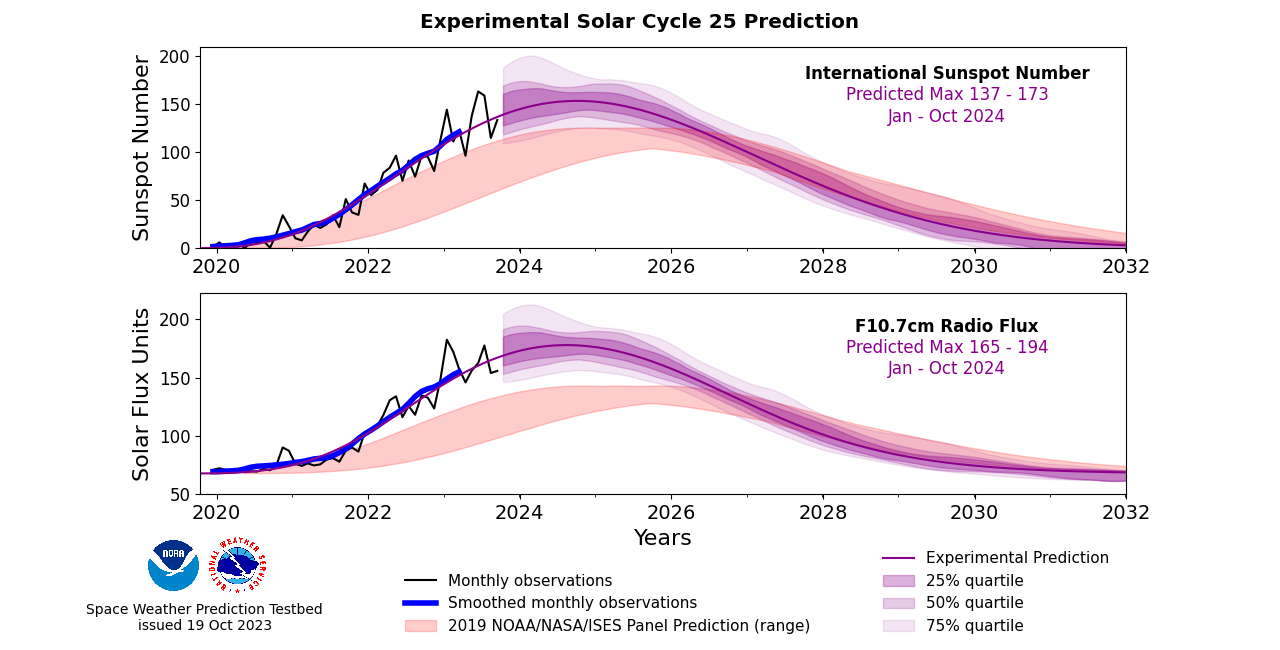 The 2019 panel, convened by NOAA, NASA and the International Space Environment Services (ISES), predicted that Solar Cycle 25, following a relatively weak Solar Cycle 24, would also be weak, peaking in July 2025 at a maximum sunspot number of 115. Solar Cycle 24 was the weakest cycle in 100 years with sunspot number peaking at 116 for the solar cycle, well below average, which is 179. NOAA’s new prediction, though larger than the panel prediction and larger than Cycle 24, would still make the strength of Solar Cycle 25 below average.
The earlier maximum in the new prediction goes hand in hand with the larger amplitude since strong cycles are known to rise faster and peak sooner. It is also good news for skywatchers; it means that the total solar eclipse that will be visible from the USA on April 8, 2024, will occur near cycle maximum. The sun may put on a good show, with a particularly impressive corona – the extended outer atmosphere of the sun that is only visible during an eclipse.
Even minor space weather events can have major impacts. After a successful launch from Cape Canaveral, Florida, in early February 2022, minor geomagnetic storming caused 38 of 49 SpaceX Starlink satellites to fail to reach their final orbit, instead burning up during unplanned re-entry into Earth’s atmosphere. While SWPC accurately predicted the space weather storm, an analysis by NOAA, CIRES and Starlink scientists published in the AGU journal Space Weather found that improved observations and forecasts for minor space weather events would help avoid future satellite losses.
SWPC’s new solar cycle prediction product was announced at the Satellite Environment Testbed Exercise held in Boulder, Colorado, from October 25 to 27. Space weather threats including satellite drag and energetic particles were the focus of an exercise and panel discussion at the event.
NOAA testbeds offer a proven way for researchers, forecasters and end users to work alongside each other to move advanced technologies and applications to operational platforms as quickly as possible. It also provides the opportunity to strategize new developments for the benefit of the public. NOAA currently operates 12 different testbeds for applications focused on hazardous weather, climate, the Arctic, aviation, hydrometeorology, and more. SWPC’s Space Weather Prediction Testbed is the latest to go into operation. NOAA’s Global Systems Laboratory is building a fire weather testbed in Boulder that will begin testing new fire weather applications in 2023.
Read more of the latest solar updates from the meteorological technology industry, here.