


Close Menu
Meteorological Technology International
  • News
    • A-E
      • Agriculture
      • Automated Weather Stations
      • Aviation
      • Climate Measurement
      • Data
      • Developing Countries
      • Digital Applications
      • Early Warning Systems
      • Extreme Weather
    • G-P
      • Hydrology
      • Lidar
      • Lightning Detection
      • New Appointments
      • Nowcasting
      • Numerical Weather Prediction
      • Polar Weather
    • R-S
      • Radar
      • Rainfall
      • Remote Sensing
      • Renewable Energy
      • Satellites
      • Solar
      • Space Weather
      • Supercomputers
    • T-Z
      • Training
      • Transport
      • Weather Instruments
      • Wind
      • World Meteorological Organization
      • Meteorological Technology World Expo
  • Features
  • Online Magazines
    • January 2026
    • April 2025
    • January 2025
    • September 2024
    • April 2024
    • Archive Issues
    • Subscribe Free!
  • Opinion
  • Videos
  • Supplier Spotlight
  • Expo
LinkedIn X (Twitter) Facebook
  • Sign-up for Free Weekly E-Newsletter
  • Meet the Editors
  • Contact Us
  • Media Pack
LinkedIn Facebook
Subscribe
Meteorological Technology International
  • News
      • Agriculture
      • Automated Weather Stations
      • Aviation
      • Climate Measurement
      • Data
      • Developing Countries
      • Digital Applications
      • Early Warning Systems
      • Extreme Weather
      • Hydrology
      • Lidar
      • Lightning Detection
      • New Appointments
      • Nowcasting
      • Numerical Weather Prediction
      • Polar Weather
      • Radar
      • Rainfall
      • Remote Sensing
      • Renewable Energy
      • Satellites
      • Solar
      • Space Weather
      • Supercomputers
      • Training
      • Transport
      • Weather Instruments
      • Wind
      • World Meteorological Organization
      • Meteorological Technology World Expo
  • Features
  • Online Magazines
    1. January 2026
    2. September 2025
    3. April 2025
    4. January 2025
    5. September 2024
    6. April 2024
    7. January 2024
    8. September 2023
    9. April 2023
    10. Archive Issues
    11. Subscribe Free!
    Featured
    November 27, 2025

    In this Issue – January 2026

    By Hazel KingNovember 27, 2025
    Recent

    In this Issue – January 2026

    November 27, 2025

    In this Issue – September 2025

    August 11, 2025

    In this Issue – April 2025

    April 15, 2025
  • Opinion
  • Videos
  • Supplier Spotlight
  • Expo
Facebook LinkedIn
Subscribe
Meteorological Technology International
Satellites

ESA prepares for Aeolus assisted re-entry

Dan SymondsBy Dan SymondsJuly 28, 20232 Mins Read
Share LinkedIn Facebook Twitter Email
Credit: ESA-ATG medialab
Share
LinkedIn Facebook Twitter Email

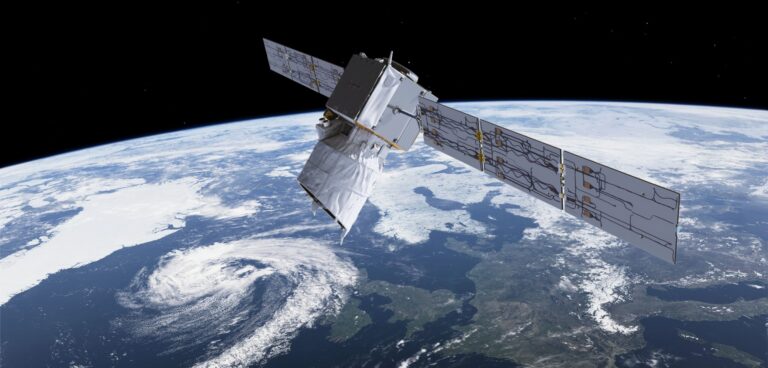
The European Space Agency’s (ESA) wind mission satellite Aeolus will begin its descent to re-enter Earth’s atmosphere this weekend (July 28).

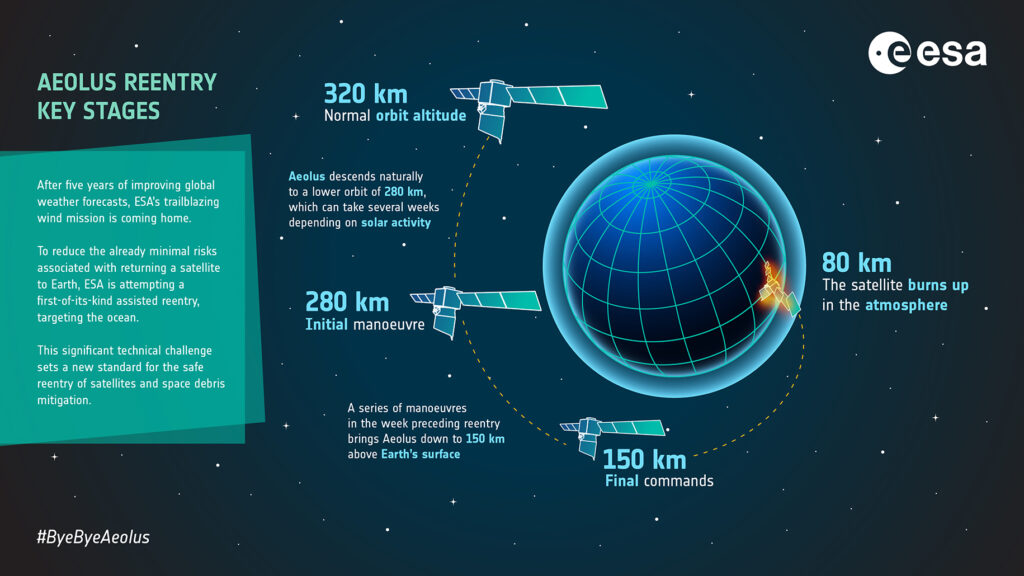
Currently orbiting 320km above Earth’s surface, it is being kept in orbit with its remaining fuel, but will soon succumb to Earth’s atmosphere and gravity.

Teams at ESA’s European Space Operations Center in Darmstadt, Germany, are busy preparing for the first-of-a-kind assisted re-entry. Analysis carried out by ESA and industry experts has demonstrated that Aeolus can re-enter through an assisted approach, in an attempt that will reduce the risk of damage from any fragments that survive the journey and reach the ground.

A series of commands and manoevers have been designed that, over a period of about a week, will passivate the spacecraft (deactivate power systems and batteries) and direct it and any remaining fragments at the sea.

If no intervention is made from the ground, Aeolus would return entirely naturally – now a common occurrence as on average one spacecraft re-enters Earth’s atmosphere per month.
Credit: ESA

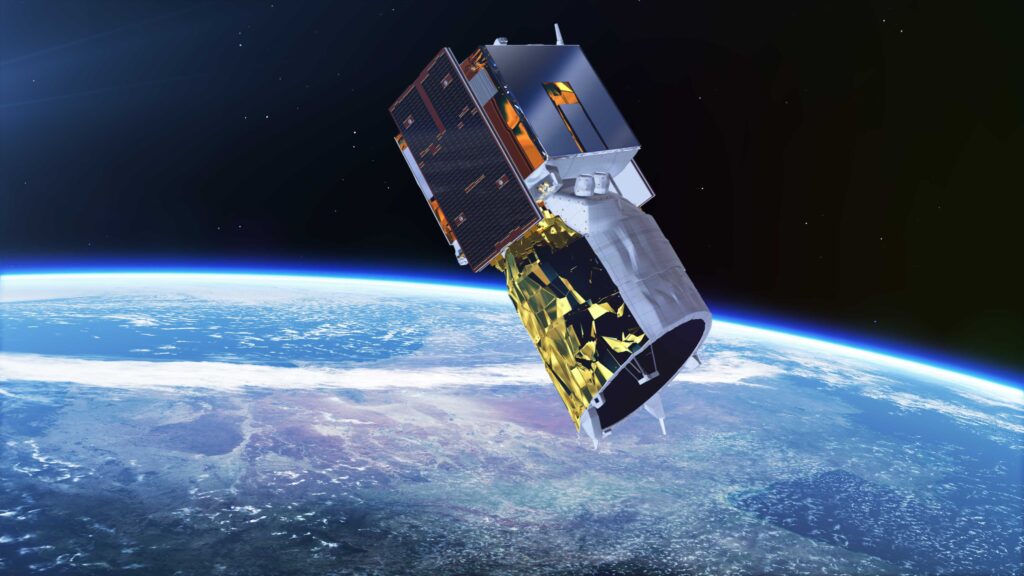
Launched on August 22, 2018, Aeolus is the first satellite mission to acquire profiles of Earth’s wind on a global scale. Aeolus carries an instrument known as ALADIN, which is Europe’s most sophisticated Doppler wind lidar flown in space. A laser fires pulses of ultraviolet light toward Earth’s atmosphere, and a receiver detects the light that is scattered back from air molecules, water molecules and aerosols such as dust.

Thanks to subtle changes in the properties of the light that is received, it is possible to measure how quickly these particles travel away from Aeolus – the speed of the wind.

Aeolus data is used by weather forecasting services worldwide, including the European Centre for Medium-Range Weather Forecasts (ECMWF), Météo-France, the UK Met Office, Germany’s Deutscher Wetterdienst (DWD), and India’s National Centre for Medium Range Weather Forecasting (NCMRWF).

Its many successes, including economic benefits valued at over €3.5bn (US$3.8bn), mean that an operational follow-on mission called Aeolus-2 will be launched within a decade.
Credit: ESA
Previous ArticleRecord UK temperatures evidence of UK’s changing climate, says Met Office
Next Article New ocean observing technologies to advance vital tsunami warning systems

Read Similar Stories

Space Weather

Northumbria University secures £4m to study Earth’s radiation belts

April 16, 20262 Mins Read
Extreme Weather

AI model improves real-time prediction of wildfire spread

April 16, 20263 Mins Read
Satellites

AI tool uses weather satellite data to map ocean currents in near real time

April 14, 20263 Mins Read
Latest News

Northumbria University secures £4m to study Earth’s radiation belts

April 16, 2026

AI model improves real-time prediction of wildfire spread

April 16, 2026

Study identifies atmospheric trigger behind flash droughts in Puerto Rico

April 15, 2026

Receive breaking stories and features in your inbox each week, for free


Enter your email address:


Supplier Spotlights
  • AIRMAR Technology Corporation
Getting in Touch
  • Contact Us / Advertise
  • Meet the Editors
  • Media Pack
  • Free Weekly E-Newsletter
Our Social Channels
  • Facebook
  • LinkedIn
© 2026 UKi Media & Events a division of UKIP Media & Events Ltd
  • Cookie Policy
  • Privacy Policy
  • Terms and Conditions
  • Notice and Takedown Policy

Type above and press Enter to search. Press Esc to cancel.