


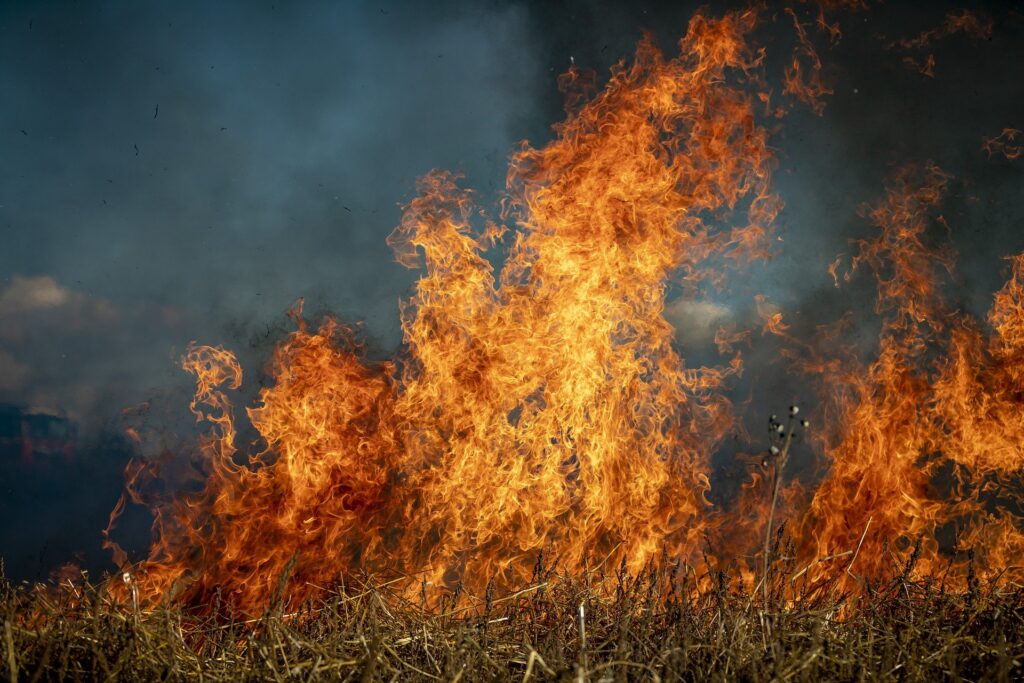
The US National Center for Atmospheric Research (NCAR) has developed a new technique that employs artificial intelligence to update vegetation maps used by wildfire computer models to accurately predict fire behavior and spread.
In a recent study, scientists demonstrated the method using the 2020 East Troublesome Fire in Colorado, which burned through land that was mischaracterized in fuel inventories as being healthy forest. In fact, the fire, which grew explosively, scorched a landscape that had recently been ravaged by pine beetles and windstorms, leaving significant swaths of dead and downed timber.
The research team compared simulations of the fire generated by a wildfire behavior model developed at NCAR using both the standard fuel inventory for the area and one that was updated with AI. The simulations that used the AI-updated fuels did a significantly better job of predicting the area burned by the fire, which ultimately grew to more than 76,900ha of land on both sides of the continental divide.
“One of our main challenges in wildfire modeling has been to get accurate input, including fuel data,” said Amy DeCastro, NCAR scientist and lead author. “In this study, we show that the combined use of machine learning and satellite imagery provides a viable solution.”
The modeling simulations were run at the NCAR-Wyoming Supercomputing Center on the Cheyenne system.
Using satellites to account for pine beetle damage
For a model to accurately simulate a wildfire, it requires detailed information about the current conditions. This includes the local weather and terrain as well as the characteristics of the plant matter that provides fuel for the flames.
The gold standard of fuel data sets is produced by LandFire, a federal program that produces several geospatial data sets including information on wildfire fuels. The process of creating these wildfire fuel data sets is extensive and incorporates satellite imagery, landscape simulation and information collected in person during surveys. However, the amount of resources necessary to produce them means that, practically speaking, they cannot be updated frequently, and disturbance events in the forest – including wildfires, insect infestations and development – can radically alter the available fuels in the meantime.
In the case of the East Troublesome Fire, which began in Grand County, Colorado, and burned east into Rocky Mountain National Park, the most recent LandFire fuel data set was released in 2016. In the intervening four years, the pine beetles had caused widespread tree mortality in the area.
To update the fuel data set, the researchers turned to the Sentinel satellites, which are part of the European Space Agency’s Copernicus program. Sentinel-1 provides information about surface texture, which can be used to identify vegetation type, while Sentinel-2 provides information that can be used to infer the plant’s health from its greenness. The scientists fed the satellite data into a machine learning model known as a ‘random forest’ that they had trained on the US Forest Service’s Insect and Disease Detection Survey. The survey is conducted annually by trained staff who estimate tree mortality from the air.
The result was that the machine learning model was able to accurately update the LandFire fuel data, turning the majority of the fuels categorized as ‘timber litter’ or ‘timber understory’ to ‘slash blowdown’ – the designation used for forested regions with heavy tree mortality.
“The LandFire data is super valuable and provides a reliable platform to build on,” DeCastro said. “Artificial intelligence proved to be an effective tool for updating the data in a less resource-intensive manner.”
To test the effect the updated fuel inventory would have on wildfire simulation, the scientists used a version of NCAR’s Weather Research and Forecasting model, known as WRF-Fire, which was specifically developed to simulate wildfire behavior.
When WRF-Fire was used to simulate the East Troublesome Fire using the unadjusted LandFire fuel data set, it substantially underpredicted the amount of area the fire would burn. When the model was run again with the adjusted data set, it was able to predict the area burned with a much greater degree of accuracy, indicating that the dead and downed timber helped fuel the fire’s spread much more so than if the trees had still been alive.
The new research at NCAR is part of a larger trend of investigating possible AI applications for wildfire, including efforts to use AI to more quickly estimate fire perimeters. NCAR researchers are also hopeful that machine learning may be able to help solve other persistent challenges for wildfire behavior modeling. For example, machine learning may be able to improve our ability to predict the properties of the embers generated by a fire (how big, how hot and how dense) as well as the likelihood that those embers could cause spot fires.
“We have so much technology and so much computing power and so many resources at our fingertips to solve these issues and keep people safe,” said Timothy Juliano, NCAR scientist and study co-author. “We’re well positioned to make a positive impact; we just need to keep working on it.”