



Researchers from Pusan National University in South Korea have identified the drivers behind the projected non-uniform warming of the Indian Ocean (IO).
According to the research, many climate projections using coupled general circulation models reveal a non-uniform warming of the IO, with warming hotspots in the Arabian Sea (AS) and the southeastern Indian Ocean (SEIO). However, there is little understanding of the mechanisms that can lead to such warming patterns and subsequently affect the weather in adjacent land areas.
To bridge this knowledge gap, a team of researchers from Korea and Japan, led by professor Kyung-Ja Ha from Pusan National University (PNU), Korea, investigated the IO warming patterns using large ensemble simulations. The researchers performed an ocean-atmosphere-based analysis using the Community Earth System Model 2 (CESM2), identifying the physical mechanisms underlying the future non-uniform IO warming.
Study author and PhD student Sahil Sharma from PNU said, “Instead of running the climate model simulation only once, we performed one hundred simulations on CESM2, which represented the different realizations of the variability in the IO climate system. This new modeling resource has been instrumental in identifying the complex ocean–atmosphere interactions responsible for modulating the IO circulation and warming patterns.”
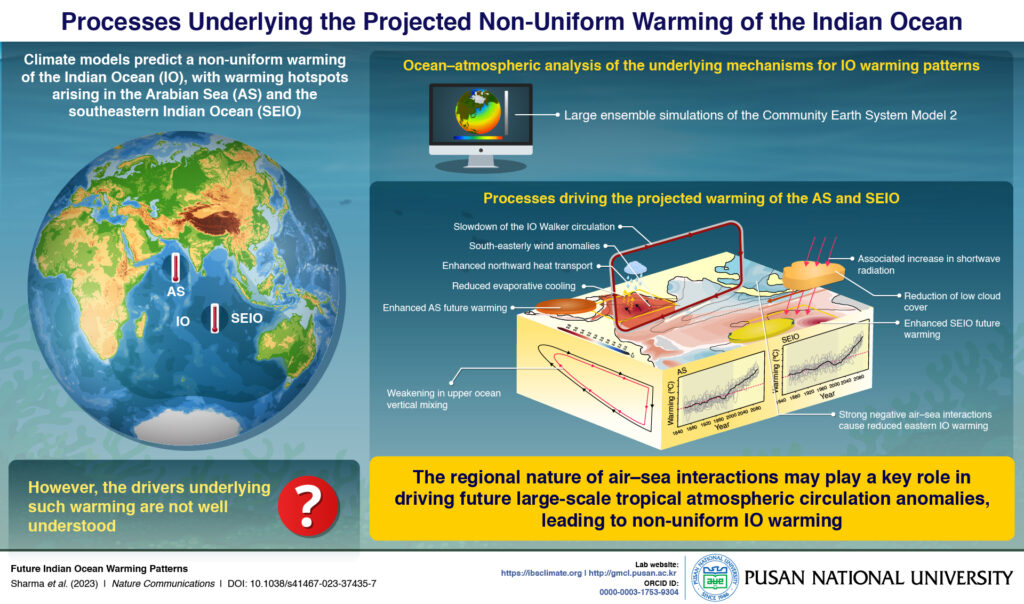 The researchers identified the air–sea interactions in the Eastern IO (EIO) — somewhere near western Indonesia — as a key driver for the warming in the AS. Here, colder deep water upwells to the surface, causing the EIO to be relatively cooler than other IO waters with weak regional warming predicted in the region. This reduced regional EIO warming is also accompanied by enhanced sea-level pressure and strong winds blowing toward the AS, which significantly alter the IO Walker circulation. These changes will cause the warmer tropical waters to move toward the AS, resulting in its warming. In addition, this will induce wetter conditions in the region due to more rainfall and less evaporation, resulting in more stable near-surface-water stratification. This development, in turn, will prevent the upwelling of deeper, cooler waters, further enhancing AS warming.
In contrast, the researchers found that the projected warming in the SEIO will be amplified by a reduction in the total low cloud cover over the region, resulting in more shortwave radiation hitting the ocean surface and causing it to warm. Therefore, the drivers for the future warming hotspots in the AS and the SEIO are quite distinct from each other, with ocean circulations modulating the former and cloud-induced heat fluxes controlling the latter phenomenon.
Based on these results, the researchers concluded that regional air–sea interactions can trigger large-scale variations in atmospheric circulations with widespread impacts even in regions outside the IO.
Highlighting the implications of the findings, Prof. Ha said, “Unless carbon dioxide emissions are drastically reduced, global warming will continue to enhance the warming in the AS with dire consequences for regional climate, marine biogeochemistry, and the African and Indian monsoon systems. This research could facilitate better marine resource management and information dissemination to fisheries and also guide future research on the effect of the projected non-uniform IO warming on regional rainfall patterns.”
To view the full study published in Nature Communications, click here.