


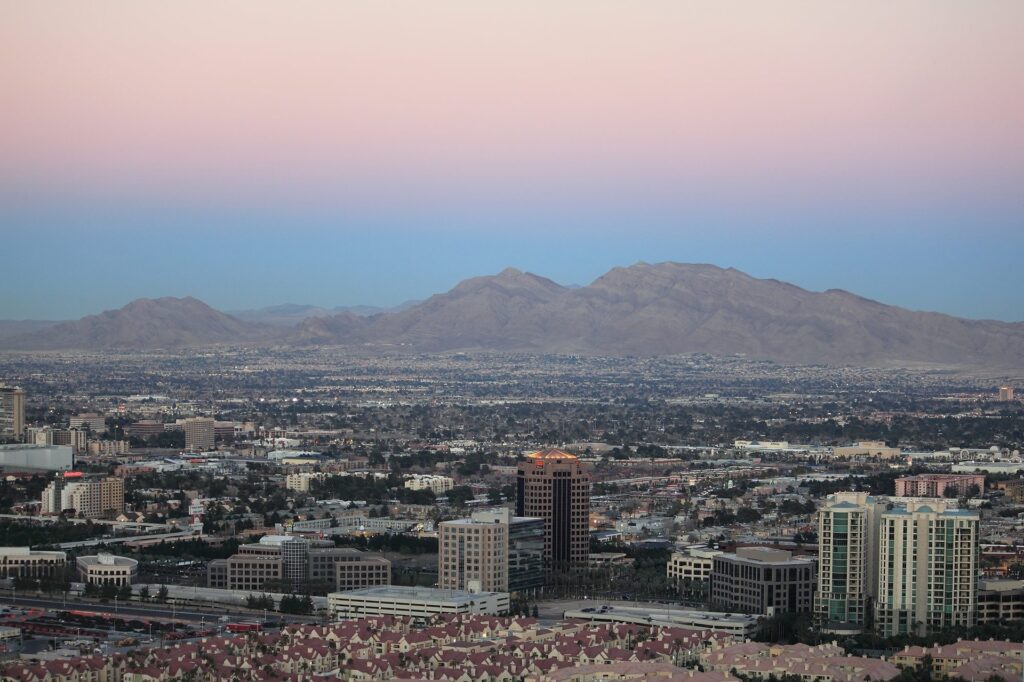
A new study has revealed that a large proportion of spring and summertime ozone pollution in Las Vegas, Nevada, may be coming from sources outside of the city.
Researchers from CIRES, a partnership between NOAA and University of Colorado Boulder (CU Boulder), found that pollution may be coming from across the Pacific Ocean and from wildfires.
The in-depth study of ozone production and transportation found that non-local ozone mixed down to the surface, contributing a striking 50-55 parts-per-billion (ppb) to ozone levels in the greater Las Vegas area during spring and early summer. This average amount represents 70-80% of the 70ppb regulatory threshold currently set by the US National Ambient Air Quality Standards (NAAQS).
Andy Langford, lead author and a scientist with NOAA’s Chemical Sciences Laboratory, said, “High background ozone levels in the western USA can certainly cause some real difficulties for regulators trying to keep ozone levels below the 70ppb threshold. The NAAQS is set at the same limit across the entire United States and doesn’t account for regional differences in background sources. In the eastern states, the background is much lower and not really an issue.”
According to the report, air quality has improved significantly in the USA over the past two decades, with broad reductions in nitrogen dioxide (NO2 ), one of the photochemical precursors of ground-level ozone, a pollutant regulated by the EPA. While NO2 (which is also regulated) has declined by approximately 38% across the country, corresponding improvements in ozone have not been uniform, with decreases of 25% in the Southeast but only 11% in the Southwest.
Weaker ozone reductions in the western states are due partly to population growth and increased emissions from oil and gas operations, but western cities such as Las Vegas are also plagued by high background ozone levels in the late spring and early summer months.
This background comes from non-local – and more importantly non-controllable – sources that create a challenge for air quality managers. These sources include stratospheric intrusions, which transport ozone-rich air downward from the stratosphere; Asian pollution transported across the Pacific and often mixed with the stratospheric intrusions; and wildfires.
These background sources are what cause surface ozone concentrations to peak at remote locations including the Grand Canyon and Great Basin National Parks in May and June, instead of July and August as is typical at most other US locations.
These new findings come from the FAST-LVOS (Fires, Asian, and Stratospheric Transport–Las Vegas Ozone Study) field study conducted in Las Vegas from May-June 2017 as a follow-up to the first LVOS project, conducted over the same period in 2013. This six-week campaign used lidar, ozonesonde balloons, aircraft, and in-situ measurements to investigate both ozone transported from California near the surface, and that originating from the stratosphere, Asia, or wildfires, and transported aloft. The study also investigated local ozone production from Las Vegas urban emissions. The Las Vegas area is currently designated by the EPA as a marginal nonattainment area for ozone.
The FAST-LVOS measurements mapped ozone in the lowest 6-8 km of the atmosphere between Las Vegas and Barstow, California. The measurements revealed persistent layers of high ozone caused by stratospheric air and Asian pollution between 3km and 6km above the surface on more than 75% of the study days. The measurements documented examples of this ozone-rich air, which had passed over California and the Sierra Nevada Mountains and been captured by the unusually deep boundary layers that form above the desert Southwest and mixed down to the surface. In some cases, this process alone can cause ground-level ozone to exceed the NAAQS threshold – even when there is little locally generated ozone. Regional wildfire influences were also seen on several days and likely contributed to high surface ozone in Las Vegas on at least one occasion.
For air quality regulators, the ability to identify stratospheric or Asian pollution ozone events is critical, since the Clean Air Act makes allowance for these “exceptional events” if they can be documented. Several such events occurred during the first LVOS campaign, but none were observed during FAST-LVOS. However, the recent campaign documented many instances when high surface ozone was created by a combination of local pollution and air mixed down from above, making the attribution much less clear cut. There is currently no regulatory mechanism to deal with the higher day-to-day background ozone levels caused by the many smaller transport events occurring in late spring and early summer.
While high background ozone in western states can certainly be a challenge during the spring and early summer, the researchers emphasized that the influence of these transport events (and thus background ozone) diminishes in July and August when local ozone production from urban pollution emissions is at its highest.
“In other words,” Langford said, “high ozone days that exceed the NAAQS later in the summer can’t really be blamed on stratospheric intrusions or Asian pollution.”
CIRES co-authored the study together with scientists in NOAA’s Chemical Sciences Laboratory, Global Monitoring Laboratory, and Global Systems Laboratory. The full report has been published in the journal Atmospheric Chemistry and Physics.