

Close Menu
Meteorological Technology International
  • News
    • A-E
      • Agriculture
      • Automated Weather Stations
      • Aviation
      • Climate Measurement
      • Data
      • Developing Countries
      • Digital Applications
      • Early Warning Systems
      • Extreme Weather
    • G-P
      • Hydrology
      • Lidar
      • Lightning Detection
      • New Appointments
      • Nowcasting
      • Numerical Weather Prediction
      • Polar Weather
    • R-S
      • Radar
      • Rainfall
      • Remote Sensing
      • Renewable Energy
      • Satellites
      • Solar
      • Space Weather
      • Supercomputers
    • T-Z
      • Training
      • Transport
      • Weather Instruments
      • Wind
      • World Meteorological Organization
      • Meteorological Technology World Expo
  • Features
  • Online Magazines
    • January 2026
    • April 2025
    • January 2025
    • September 2024
    • April 2024
    • Archive Issues
    • Subscribe Free!
  • Opinion
  • Videos
  • Supplier Spotlight
  • Expo
LinkedIn X (Twitter) Facebook
  • Sign-up for Free Weekly E-Newsletter
  • Meet the Editors
  • Contact Us
  • Media Pack
LinkedIn Facebook
Subscribe
Meteorological Technology International
  • News
      • Agriculture
      • Automated Weather Stations
      • Aviation
      • Climate Measurement
      • Data
      • Developing Countries
      • Digital Applications
      • Early Warning Systems
      • Extreme Weather
      • Hydrology
      • Lidar
      • Lightning Detection
      • New Appointments
      • Nowcasting
      • Numerical Weather Prediction
      • Polar Weather
      • Radar
      • Rainfall
      • Remote Sensing
      • Renewable Energy
      • Satellites
      • Solar
      • Space Weather
      • Supercomputers
      • Training
      • Transport
      • Weather Instruments
      • Wind
      • World Meteorological Organization
      • Meteorological Technology World Expo
  • Features
  • Online Magazines
    1. January 2026
    2. September 2025
    3. April 2025
    4. January 2025
    5. September 2024
    6. April 2024
    7. January 2024
    8. September 2023
    9. April 2023
    10. Archive Issues
    11. Subscribe Free!
    Featured
    November 27, 2025

    In this Issue – January 2026

    By Hazel KingNovember 27, 2025
    Recent

    In this Issue – January 2026

    November 27, 2025

    In this Issue – September 2025

    August 11, 2025

    In this Issue – April 2025

    April 15, 2025
  • Opinion
  • Videos
  • Supplier Spotlight
  • Expo
Facebook LinkedIn
Subscribe
Meteorological Technology International
News

Researchers find airborne microplastics in clouds

William AtkinsonBy William AtkinsonOctober 4, 20233 Mins Read
Share LinkedIn Facebook Twitter Email
Share
LinkedIn Facebook Twitter Email

It is well known that plastic waste that accumulates on land eventually ends up in the ocean as microplastics. It is now speculated that microplastics are also present in the atmosphere, held in clouds.

Microplastics are plastic particles less than 5mm in size. They are often found in industrial effluent or form from the degradation of bulkier plastic waste. Research shows that large amounts of microplastics are ingested or inhaled by humans and animals and have been detected in the lungs, heart, blood, placenta and feces.

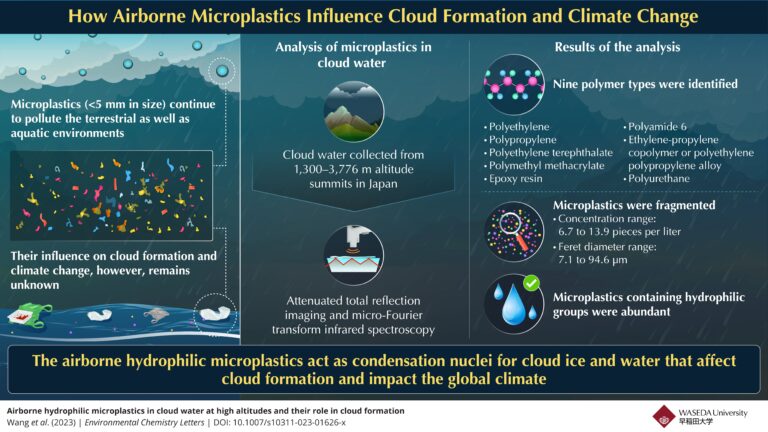
Microplastics end up in the ocean and are then released by the ocean spray and find their way into the atmosphere. They may have become an essential component of clouds, contaminating nearly everything we eat and drink via ‘plastic rainfall’. While most studies on microplastics have focused on aquatic ecosystems, few have looked into their impact on cloud formation and climate change as airborne particles.

In a new study led by Professor Hiroshi Okochi at Waseda University, a group of researchers has explored the path of airborne microplastics (AMPs) as they circulate in the biosphere, adversely affecting human health and the climate. Their study was recently published in the journal Environmental Chemistry Letters with contributions from co-authors Yize Wang from Waseda University and Yasuhiro Niida from PerkinElmer Japan Co. Ltd.

“Microplastics in the free troposphere are transported and contribute to global pollution,” explained Okochi. “If the issue of ‘plastic air pollution’ is not addressed proactively, climate change and ecological risks may become a reality, causing irreversible and serious environmental damage in the future.”

To investigate the role of these tiny plastic particles in the troposphere and the atmospheric boundary layer, the team collected cloud water from the summit and foothills of Mount Fuji, and the summit of Mount Oyama – regions at altitudes ranging from 1,300-3,776m. Using advanced imaging techniques including attenuated total reflection imaging and micro-Fourier transform infrared spectroscopy (µFTIR ATR imaging), the researchers determined the presence of microplastics in the cloud water and examined their physical and chemical properties.

They identified nine types of polymers and one type of rubber in the AMPs detected. Notably, most of the polypropylene that was detected in the samples was degraded and had carbonyl (C=O) and/or hydroxyl (OH) groups. The Feret diameters of these AMPs ranged from 7.1-94.6µm, the smallest seen in the free troposphere. Moreover, the presence of hydrophilic polymers in the cloud water was abundant, suggesting that they were removed as cloud condensation nuclei. These findings confirm that AMPs play a key role in rapid cloud formation, which may eventually affect the overall climate.

Accumulation of AMPs in the atmosphere, especially in the polar regions, could cause major changes in the ecological balance of the planet, leading to severe loss of biodiversity. Okochi concluded by saying, “AMPs are degraded much faster in the upper atmosphere than on the ground due to strong ultraviolet radiation, and this degradation releases greenhouse gases and contributes to global warming. As a result, the findings of this study can be used to account for the effects of AMPs in future global warming projections.”

Previous ArticleVaisala launches Beam Weather Station for hyperlocal weather monitoring
Next Article Unprecedented September temperatures to make 2023 the warmest year on record, Copernicus reports

Read Similar Stories

News

Global sea surface temperatures at record high, Copernicus finds

March 8, 20245 Mins Read
Data

ECMWF releases a much larger open data set

March 8, 20243 Mins Read
Data

NBOSI launches integrated CTD sensor

March 7, 20242 Mins Read
Latest News

Northumbria University secures £4m to study Earth’s radiation belts

April 16, 2026

AI model improves real-time prediction of wildfire spread

April 16, 2026

Study identifies atmospheric trigger behind flash droughts in Puerto Rico

April 15, 2026

Receive breaking stories and features in your inbox each week, for free


Enter your email address:


Supplier Spotlights
  • Geolux d.o.o.
Getting in Touch
  • Contact Us / Advertise
  • Meet the Editors
  • Media Pack
  • Free Weekly E-Newsletter
Our Social Channels
  • Facebook
  • LinkedIn
© 2026 UKi Media & Events a division of UKIP Media & Events Ltd
  • Cookie Policy
  • Privacy Policy
  • Terms and Conditions
  • Notice and Takedown Policy

Type above and press Enter to search. Press Esc to cancel.